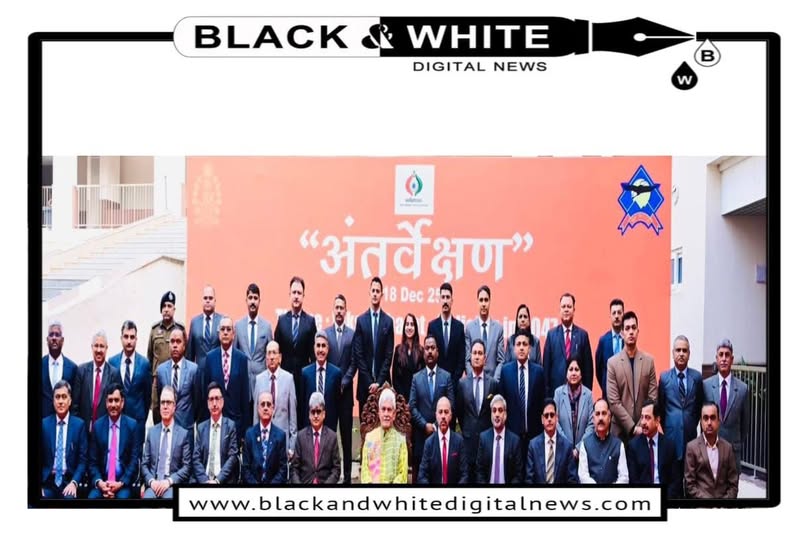
Antarvekshan 2025 Highlights J&K Police Transformation Aligned with Viksit Bharat 2047
||Black and White Digital News ||
||Parvinder Singh December 19,2025||
The UT-level conference “Antarvekshan 2025,” chaired by the Hon’ble Lieutenant Governor of Jammu and Kashmir, Shri Manoj Sinha, held at Jammu, represented a significant institutional moment in the continuing evolution of policing and internal security discourse in the Union Territory. Conceptualised on the lines of the DsGP and IsGP Conferences, Antarvekshan 2025 sought to create a comprehensive, forward-looking platform that went beyond senior-level deliberations and deliberately included cutting-edge operational perspectives from the grassroots to the strategic leadership level.
The breadth of participation was one of the defining features of the conference. Officers of the J&K Police from the rank of Sub-Inspector to senior leadership participated alongside personnel from Home Guards, Civil Defence and SDRF, the Prosecution wing, Fire and Emergency Services, and Central Armed Police Forces. This multi-agency presence reflected an institutional recognition that contemporary security and governance challenges in J&K cannot be addressed in isolation by any single force or department. Instead, internal security, public safety, criminal justice delivery and disaster response increasingly demand coordinated planning, shared situational awareness and interoperable systems.
The participation of 375 police officers in person, supplemented by 90 officers attending virtually, underscored both the scale of engagement and the adoption of hybrid formats to democratise access to strategic dialogue. The presence of senior civil and technical leadership added further depth to the proceedings. The Forensic Advisor to the Government of Assam, Shri Keshav Kumar, brought national-level expertise on scientific investigation and evidentiary standards, an area of growing importance in ensuring credibility and sustainability of prosecutions. Chief Secretary Shri Atal Dulloo’s participation anchored the discussions within the larger administrative and governance framework of the Union Territory, reinforcing the principle that effective policing is inseparable from responsive governance. The presence of the Director of IIT Jammu, Prof Manoj Singh Gaur, signalled a deliberate and forward-looking engagement with academia and technology institutions, reflecting the police leadership’s emphasis on innovation-driven capacity building.
The six technical sessions collectively mapped the present challenges and future trajectory of policing in Jammu and Kashmir. The discussion on “Imperatives for JKP in Viksit Bharat: Policing in 2047” placed the force within the national vision of a developed India, encouraging officers to internalise long-term institutional goals rather than remain confined to immediate operational compulsions. In the specific context of J&K, where policing has long been shaped by extraordinary security pressures, this session invited reflection on how the force must evolve into a more citizen-centric, technology-enabled and professionally resilient institution by the time India reaches its centenary of independence.
The session on the role of artificial intelligence in policing reflected the growing centrality of data, automation and predictive tools in law enforcement. Discussions focused on how AI can enhance crime analysis, intelligence processing, surveillance, traffic management and resource deployment, while also acknowledging the need for safeguards related to ethics, privacy and accountability. For a region like J&K, where security sensitivity is high and public trust is critical, the emphasis on responsible and calibrated use of technology carried particular relevance.
Deliberations on terrorism and foreign interference addressed the enduring security challenges facing the Union Territory, while also recognising the changing nature of threats. The focus extended beyond traditional militancy to include cross-border facilitation, digital propaganda, radicalisation through online platforms and hybrid tactics. The discussion highlighted the importance of intelligence-led operations, technological support systems and inter-agency coordination, while situating counter-terror measures within the broader objective of maintaining normalcy and enabling socio-economic development.
The role of police stations in internal security and public service delivery emerged as a critical theme, shifting attention to the foundational unit of policing. Emphasis was placed on the police station as the primary interface between the state and the citizen, where trust, legitimacy and service orientation are built on a daily basis. In the context of J&K’s transition towards stability and normal civic life, strengthening police stations as centres of responsive governance, grievance redressal and community engagement was underscored as essential.
The session on successful investigation and prosecution reinforced the decisive role of forensics and technology in improving the quality of investigations and ensuring higher conviction rates. The emphasis on scientific methods reflected a clear move towards evidence-based policing, reducing dependence on traditional practices and aligning investigative standards with constitutional safeguards and judicial expectations. This theme also highlighted the importance of seamless coordination between investigators, forensic experts and prosecutors, ensuring that cases withstand legal scrutiny from crime scene to courtroom.
The discussion on the role of police in disaster management drew attention to a vital but often understated responsibility. Given the geographical, climatic and seismic vulnerability of Jammu and Kashmir, the police, along with SDRF, Civil Defence and Fire Services, play a crucial role as first responders during natural and man-made disasters. The session reinforced the need for preparedness, specialised training, inter-agency coordination and community awareness to minimise loss of life and property during emergencies.
A major institutional outcome of Antarvekshan 2025 was the signing of a Memorandum of Understanding between the J&K Police and IIT Jammu. This MoU symbolised a strategic commitment to sustained collaboration in areas such as technology development, research, innovation and specialised training. It reflected an understanding that long-term modernisation of policing requires continuous engagement with technical institutions capable of translating emerging technologies into practical policing solutions.
The briefings by the Director General of Police, Shri Nalin Prabhat, SDG Coordination Shri SJM Gillani and ADG Headquarters Shri MK Sinha provided operational clarity and leadership direction. Their addresses emphasised ongoing reforms, capacity enhancement and the need for adaptive leadership in a complex security environment. Together, they conveyed a message of institutional continuity combined with readiness for transformation.
Overall, Antarvekshan 2025 emerged as more than a routine conference. It functioned as a reflective and strategic forum that integrated security imperatives, governance priorities and technological innovation within a single narrative. By bringing together leadership, field officers, technical experts and civil administration, the conference articulated a vision of policing in Jammu and Kashmir that is forward-looking, collaborative and aligned with the broader national aspiration of Viksit Bharat, while remaining firmly grounded in the unique realities of the Union Territory.