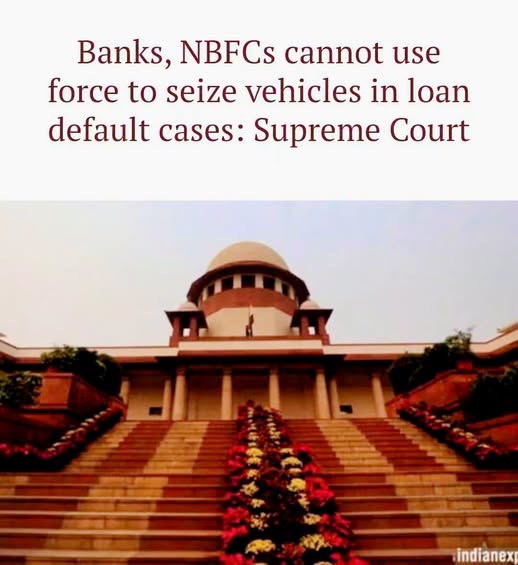
SC Bars Banks, NBFCs From Using Force to Seize Vehicles in Loan Defaults
||Black and White Digital News ||
||Parvinder Singh Sept 19,2026||
New Delhi : The Supreme Court has reiterated that banks and Non-Banking Financial Companies (NBFCs) cannot use force or coercive methods to seize vehicles financed through loans when borrowers default on repayments.
A bench comprising Justices P S Narasimha and Alok Aradhe observed that the guidelines issued by the Reserve Bank of India (RBI) to prevent such practices have, in several instances, remained “only on paper”, with little effective implementation.
The court directed the RBI to take “effective steps to secure genuine compliance” with its guidelines and circulars governing loan recovery and repossession of financed assets.
Justice Alok Aradhe, in the judgment, said a financier’s right to take possession of a financed vehicle at the first instance arises from the contract between the lender and borrower. Such arrangements, the court noted, make it commercially feasible for financial institutions to extend credit against the security of the asset being financed, particularly to borrowers with limited means.
However, the court stressed that this contractual right is not unlimited.
Since repossession can initially take place without direct supervision by a court, the power must be exercised with “great circumspection”, the bench said. It cautioned that, if left unchecked, the right could be misused as an “unbridled licence” to seize property through stealth, force or at night.
Such practices, the court observed, could turn a facility intended to promote financial inclusion into an instrument of oppression against the very borrowers it was designed to serve.
The matter arose from an appeal filed by a borrower who had obtained a commercial vehicle loan from Cholamandalam Investment and Finance Company Ltd for purchasing a truck. The dispute brought before the court concerned the manner in which the financed vehicle was taken into possession following a loan default.
The Supreme Court’s observations underline that while lenders may have contractual and legal remedies to recover outstanding dues and repossess secured assets, those remedies must be exercised in accordance with the law and applicable RBI regulations.
The ruling also places renewed emphasis on the RBI’s responsibility to ensure that its existing safeguards against coercive recovery practices are effectively implemented by banks, NBFCs and their recovery agents.