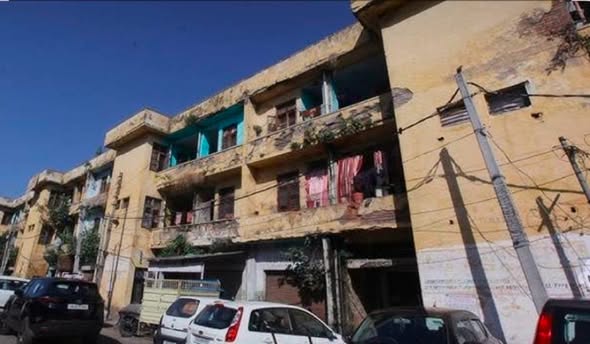
Satya Niketan Collapse: Seven Lives Lost, Five MCD Officials Suspended — Jammu Must Act Before Unsafe Buildings Turn Into Another Tragedy
||Black and White Digital News ||
||Parvinder Singh Sept 07,2026 ||
NEW DELHI/JAMMU : The tragic collapse of a five-storey building housing a private paying-guest facility at Satya Niketan in southwest Delhi, which has claimed seven lives and left several others injured, has once again brought the issue of unsafe buildings, regulatory failure and official accountability into sharp focus. The tragedy has also raised a disturbing question for Jammu: how many buildings already identified as unsafe are still standing, waiting for demolition or other corrective action?
The Satya Niketan building, reportedly around five decades old, collapsed on Sunday while repair work was allegedly being carried out in its basement. Preliminary reports have pointed towards water accumulation and ongoing repair work as possible factors, while allegations concerning structural alterations and violations of building norms are also under investigation. The authorities have arrested the building owner, and an inquiry into the circumstances surrounding the collapse is underway.
In the immediate aftermath of the tragedy, the Municipal Corporation of Delhi took an unusually strong administrative step by suspending five South Zone officials, including the Deputy Commissioner, Superintending Engineer, Executive Engineer (Building), Assistant Engineer (Building) and Junior Engineer (Building), pending disciplinary proceedings.
The action is significant because it recognises that responsibility for public safety cannot end with property owners. Civic officials entrusted with building regulation, inspection and enforcement also have a responsibility to ensure that known violations and dangerous conditions are addressed before they result in loss of life.
Yet the suspension of officials, while necessary if negligence is established, cannot by itself constitute justice for the families who have lost their loved ones. No administrative order can bring back the seven people who died beneath the rubble. For their families, genuine justice requires answers about whether the danger was known, whether complaints or warnings had been received, whether inspections had taken place, whether violations were detected, whether officials had acted on those violations and, most importantly, whether the tragedy could have been prevented had timely action been taken.
That is the central issue emerging from Satya Niketan. The question is not merely who will be punished after a building collapses; it is who was responsible for ensuring that it did not collapse in the first place.
Delhi’s response has also included plans for wider structural audits and stronger scrutiny of buildings being used for public purposes such as hostels and PG accommodation. The Delhi Government has indicated that dangerous buildings will face structural audits and appropriate action, while the civic administration has reiterated its intention to act against unauthorised construction.
But the tragedy also exposes a larger weakness in India’s urban governance system: authorities often possess information about dangerous or unauthorised structures long before disaster strikes, yet enforcement can remain slow, fragmented or vulnerable to delay.
This is precisely why Jammu must take the Satya Niketan tragedy as a warning rather than wait for a similar disaster.
The administration needs to urgently establish the present status of every building in Jammu city and its adjoining areas that has been declared unsafe, dangerous, structurally vulnerable or unfit for occupation. The public deserves to know how many such buildings have been identified, how many notices have been issued, how many have been ordered to be vacated, repaired or demolished and, most importantly, how many demolition or safety-related cases are still pending despite the authorities being aware of the danger.
The responsibility in Jammu cannot be viewed through the lens of a single department. The Jammu Municipal Corporation and the Jammu Development Authority have responsibilities within their respective jurisdictions and statutory powers concerning building regulation, enforcement and action against unsafe or unauthorised structures. JMC has itself stated that it is intensifying enforcement against unauthorised construction and has recently carried out demolition action against violations of building norms.
The issue, therefore, is not whether JMC or JDA have the authority to act. The more serious question is whether that authority is being exercised promptly, transparently and without political, personal or commercial interference when the safety of citizens is at stake.
An unsafe building cannot be allowed to remain occupied simply because its file is pending. A demolition order cannot remain on paper indefinitely when a structure poses an imminent threat. A complaint about structural danger cannot be allowed to disappear into administrative correspondence until a wall, roof or entire building comes crashing down.
The recent judicial proceedings involving the Jammu Municipal Corporation also underline the importance of following due process and exercising statutory powers strictly within the law. In May this year, the Jammu and Kashmir High Court questioned the manner in which demolition-related action had been undertaken in one matter and stressed adherence to due process.
That principle is equally important in dealing with unsafe buildings. Authorities must act firmly, but they must act lawfully. Property owners have legal rights, but those rights cannot override the public’s right to life and safety. Similarly, enforcement agencies must not use building regulations selectively or arbitrarily.
The real challenge is to create a system in which a dangerous building is identified, independently assessed, formally recorded, occupied only if it is safe, and subjected to a definite time-bound decision where it is not. If demolition is required, the process should not be delayed without a legally defensible reason. If evacuation is required, it must happen before people are trapped inside. If repairs are permissible, they must be supervised and certified by competent authorities.
The question of accountability becomes even more serious when officials have prior knowledge of a dangerous structure.
If an unsafe building in Jammu collapses tomorrow and people die, the inevitable question will be: who knew about its condition, who had the authority to act and why was action not taken?
That does not mean that every officer associated with a building automatically becomes criminally liable after a collapse. Legal responsibility must always be determined from the evidence, the officer’s statutory duties, the information available to the officer, the action taken and whether negligence or dereliction of duty is established.
But where the administration has formally identified a building as dangerous, where competent officials have been informed, where statutory powers exist to require evacuation, repair, securing or demolition, and where an unreasonable failure to act contributes to a subsequent disaster, the conduct of those responsible cannot simply be ignored. It could invite disciplinary scrutiny and, depending on the evidence and applicable law, potentially further legal consequences.
This is where the Satya Niketan episode should serve as a whistle-blower moment for Jammu.
Citizens, residents, journalists, engineers and public representatives should not have to wait for a collapse before their warnings are taken seriously. Every credible complaint concerning an unsafe building should result in a documented inspection and a time-bound decision. The identity of the responsible authority should be clear, and the status of pending cases should be traceable.
There should also be no room for political interference.
Building safety cannot be allowed to become a question of influence. If a structure is unsafe, the law must apply irrespective of who owns it, occupies it or supports it. If an officer has failed in his or her statutory duty, action should follow on the basis of evidence. Equally, an officer who has acted properly should not become a scapegoat merely because a tragedy has occurred.
The public needs to see a system in which accountability is established before tragedy, rather than announced after it.
The Delhi Government’s decision to suspend five officials after the Satya Niketan collapse may send a strong message that negligence will not be tolerated. But the strongest message would be delivered if this action results in a preventive nationwide review of dangerous buildings rather than another cycle of tragedy, suspension, inquiry and eventual public forgetfulness.
For Jammu, the warning could not be clearer.
JMC and JDA must identify and review every unsafe building under their respective jurisdictions before the next monsoon, before the next structural failure and, above all, before another family loses a loved one.
If there are buildings already declared unsafe but still awaiting demolition, the public has a legitimate right to know why they are still standing and who is responsible for the delay.
Because if such a building collapses after the authorities have already been warned, the issue will no longer be one of mere administrative delay.
It will become a question of accountability.
And the question from the families of the victims will be painfully simple:
“If you already knew the building was unsafe, why did you wait until people died?”
The real lesson of Satya Niketan is therefore not that five officials can be suspended after seven deaths.
It is that seven deaths should never have been necessary to make the system act.
**Jammu must ensure that it does not learn the same lesson only after its own Satya Niketan.**