LEH, LADAKH — June 18, 2026 :
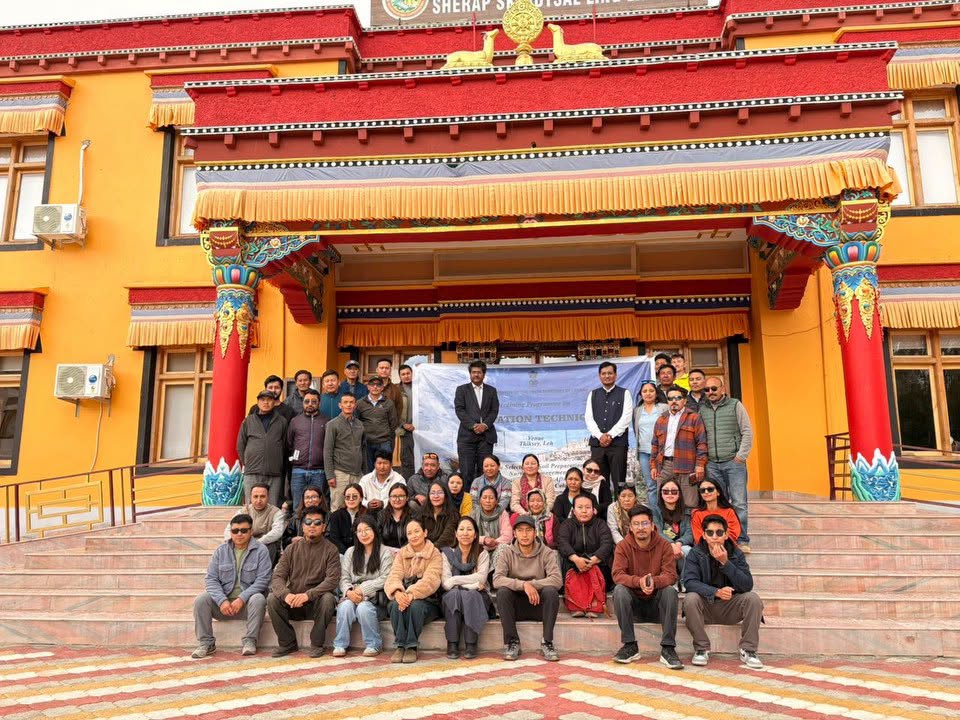
In a major push towards enhancing the green cover and ecological resilience of the fragile trans-Himalayan ecosystems, the Leh Forest Division successfully organized a comprehensive “Theory-Cum-Field Training Program on Forestry Plantation Techniques” for its frontline field staff.
The training session was conducted by Shri Amarjeet Kujur, IFS, DCF and was chaired by Shri Rajesh S., IFS, Addl Principal Chief Conservator of Forests / Chief Wildlife Warden UT Ladakh.
The Addl. PCCF in the inaugural address underlined the importance of skill perfection in cold desert tree plantation techniques to realize high value outcomes in eco- restoration, community forestry, food forest development, promotion of agroforestry etc., in the UT Ladakh.
The training focused heavily on specialized plantation techniques explicitly engineered to overcome the severe climatic constraints of high-altitude cold deserts. The training combined intensive classroom instruction with a rigorous, hands-on practical on field workshop. Frontline staff including forest guards and block officers were equipped with data-driven methodologies to optimize sapling survival rates and conserve vital water resources.
The program was structurally split between scientific theory and direct field implementation, tackling the unique challenges of Ladakh’s terrain through five specialized modules:
Climate-Resilient Species Selection:Training focused on prioritizing ecological adaptation. Staff analyzed the performance of native and highly adaptable species including Salix (Willow), Poplar, Apple, Apricot and Juniperus polycarpos(Shukpa) balancing ecological stabilization with local community needs.
Advanced Plantation Techniques: Participants learned to construct strategic micro-catchments and specialized trenches designed to trap drifting snow, block harsh winds, and maximize the collection of minimal precipitation.
Soil Structure & Nutrient Improvement: Recognizing Ladakh’s sandy, porous, and nutrient-deficient soil matrix, the technical sessions demonstrated organic soil conditioning. Staff practiced integrating structural binders, organic compost, and moisture-retaining natural additives to establish a healthy rhizosphere (the soil zone directly surrounding plant roots).
Arid-Zone Irrigation Engineering: To combat extreme water scarcity, the module highlighted efficient water deployment. Techniques focused on localized deep-root watering, sub-surface moisture conservation, and structural designs to minimize evaporation losses under intense high-altitude UV radiation.
Hands-on Field Workshop: Moving from theory to practice, the field staff executed real-time earthwork. The team prepared plantation beds, mixed optimized soil configurations, and practiced precision root-handling techniques on live saplings.
“Greening a high-altitude cold desert requires moving past standard forestry practices”, noted the DCF Sh. Amarjeet Kujur during the concluding session. Every sapling we plant faces severe climatic stress. By training our frontline staff in precise moisture conservation and targeted soil improvement, we shift our focus from just “numbers planted” to “Long-term survival rates”.
The Leh Forest Division plans to immediately deploy these standardized techniques across all upcoming community, institutional, and departmental afforestation drives under the Indus River Green Corridor Initiative, Ladakh Trans Himalayan Cold Desert Urban Forestry and Food Forest Initiative, Community wood lot initiatives of the Department of Forest, Ecology and Environment, UT Ladakh. The Leh Forest Division also sincerely thanks the Thiksey Gonpa for helping us organise the training and actively participating in the greening initiative at Thiksey.
See less