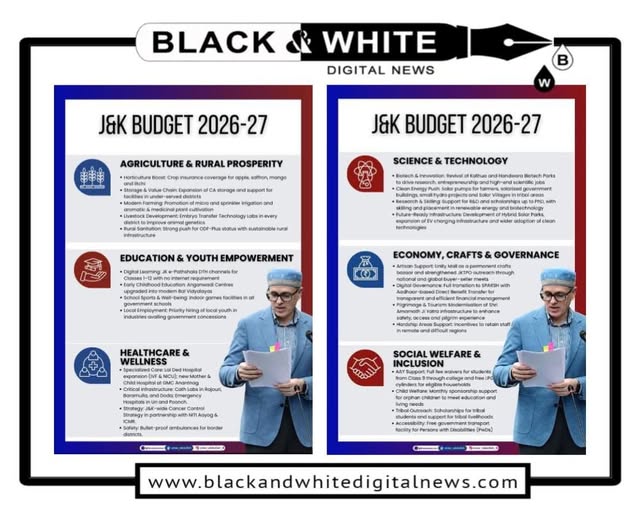
J&K Budget 2026–27: A Blueprint for Grassroots Growth, Human Development and Future-Ready Jammu & Kashmir.
||Black and White Digital News||
||Tejveer Singh February 06,2026||
The Jammu and Kashmir Budget 2026–27 presents itself as a forward-looking policy document that attempts to balance immediate welfare needs with long-term structural reforms. With a clear thrust on agriculture, education, healthcare, technology, and inclusive governance, the budget outlines a vision of development that is both people-centric and sustainability-driven.
Agriculture & Rural Prosperity:
Strengthening the Backbone
Agriculture, the traditional backbone of J&K’s economy, receives focused attention in the budget. A major highlight is the expansion of crop insurance coverage for key horticulture produce such as apple, saffron, mango, and litchi, an assurance mechanism aimed at insulating farmers from climate and market shocks.
The government has also proposed strengthening the storage and value chain ecosystem, particularly through the expansion of Controlled Atmosphere (CA) storage facilities in under-served districts. This move is expected to reduce post-harvest losses and enhance farmers’ income.Promotion of modern farming techniques, including micro and sprinkler irrigation systems, alongside the cultivation of aromatic and medicinal plants, reflects a shift towards diversification and water-efficient agriculture.
In the livestock sector, the introduction of Embryo Transfer Technology (ETT) labs in every district aims to improve animal genetics and productivity.
Complementing economic initiatives, the budget reiterates a strong push towards ODF-Plus rural sanitation, integrating infrastructure development with public health outcomes.
Education & Youth Empowerment:
Investing in Human Capital; The budget places education and youth empowerment at the core of J&K’s development agenda. A notable initiative is the launch of JK e-Pathshala DTH channels, enabling digital learning for Classes I–XII without the need for internet connectivity, an inclusive step for remote and border areas.
Early childhood education is set to be strengthened through the modernisation of Anganwadi Centres into Bal Vidyalayas, while government schools will be equipped with indoor sports facilities to promote holistic well-being.Importantly, the budget emphasizes local employment, mandating priority hiring of local youth in industries availing government concessions, an attempt to align industrial growth with regional job creation.
Healthcare & Wellness:
Expanding Access and Safety
Healthcare emerges as another priority sector. The expansion of Lal Ded Hospital with IVF and NICU facilities, along with the establishment of a Mother & Child Hospital at GMC Anantnag, signals a focused approach to maternal and child health.
Critical healthcare infrastructure is proposed through new Cath Labs in Rajouri, Baramulla, and Doda, and Emergency Hospitals in Uri and Poonch, addressing long-standing gaps in peripheral and border districts. The budget also announces a J&K-wide Cancer Control Strategy in collaboration with NITI Aayog and ICMR.
In a unique move acknowledging ground realities, bullet-proof ambulances for border districts have been proposed, underlining a blend of healthcare planning with security considerations.
Science & Technology:
Driving Innovation and Clean Energy
The Science & Technology component of the budget focuses on innovation-led growth. The revival of Kathua and Handwara Biotech Parks aims to foster research, entrepreneurship, and high-end employment opportunities.A strong clean energy push is visible through solar pumps for farmers, solarisation of government buildings, small hydro projects, and the development of solar villages in tribal areas. The budget also supports R&D, scholarships up to PhD level, and skill development with placement opportunities in renewable energy and biotechnology.
Future-ready infrastructure finds space with proposals for Hybrid Solar Parks, expansion of EV charging infrastructure, and wider adoption of clean technologies.
Economy, Crafts & Governance:
Transparency and Cultural Economy;To strengthen the local economy, the budget proposes a Unity Mall as a permanent crafts bazaar, coupled with enhanced JKTPO outreach through national and global buyer–seller meets, offering new markets to artisans.
On the governance front, a full transition to SPARSH with Aadhaar-based Direct Benefit Transfer (DBT) is expected to improve transparency and efficiency in financial management.Pilgrimage and tourism infrastructure, particularly the modernisation of Shri Amarnath Ji Yatra facilities, has been prioritised to enhance safety, accessibility, and pilgrim experience. Additionally, incentives for staff retention in hardship and remote areas acknowledge the human resource challenges in difficult terrains.
Social Welfare & Inclusion:
The budget reinforces social justice through comprehensive welfare measures. Under AAY support, full fee waivers for students from Class 9 through college and free LPG cylinders for eligible households have been announced.Orphan children will receive monthly sponsorship support to meet education and living needs, while scholarships for tribal students and livelihood support for tribal communities aim to bridge socio-economic disparities.Accessibility measures include free government transport facilities for Persons with Disabilities (PwDs), reinforcing the budget’s inclusive ethos.
The J&K Budget 2026–27 positions itself as a holistic roadmap addressing immediate welfare imperatives while laying the foundation for a resilient, inclusive, and innovation-driven Jammu and Kashmir. Its success, however, will hinge on timely implementation, transparent execution, and sustained monitoring to ensure that policy intent translates into real change on the ground.