BJP’s National Office-Bearers List Triggers Questions Over J&K Representation, Leadership and Ground-Level Performance
||Black and White Digital News ||
||Parvinder Singh Aug 19, 2026 ||
Jammu: The recent announcement of the BJP’s national office-bearers has triggered political debate in Jammu and Kashmir, with questions being raised over the representation of the Union Territory in the party’s national organisational structure and the future political positioning of several prominent leaders.
The reshuffle has particularly drawn attention because a number of senior J&K BJP leaders who were seen as important contenders for positions at the national level have reportedly failed to find a place in the latest arrangement. The developments have sparked discussion within political circles over whether Jammu and Kashmir has received adequate organisational representation and whether the changes could have an impact on the future of several established leaders.
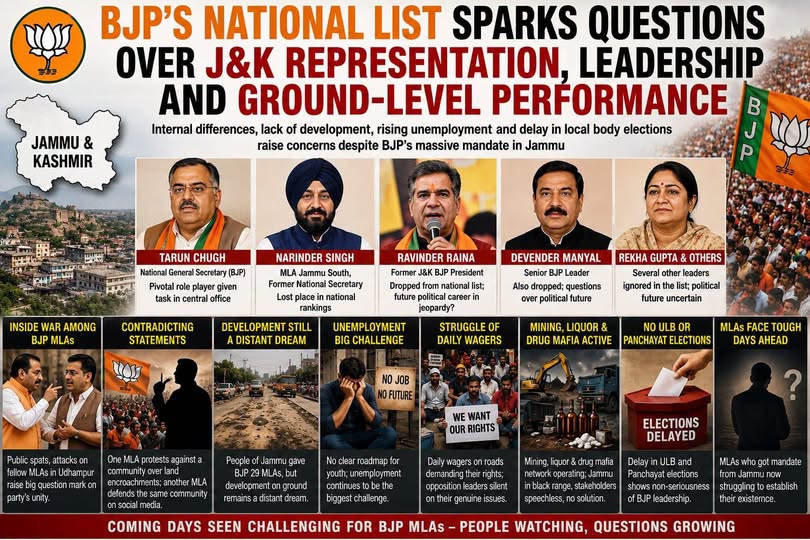
BJP national general secretary Tarun Chugh, who has played a significant organisational role in Jammu and Kashmir, has been assigned responsibilities at the party’s central office. While his continued presence in the national organisation underlines his importance, questions are simultaneously being raised about whether the J&K unit has lost a degree of visionary and influential leadership at the national level.
Similarly, Dr Narinder Singh, BJP MLA from Jammu South and a former national secretary of the party, is also being discussed in political circles following the latest organisational changes. His absence from the new national line-up has fuelled speculation about the future organisational roles of several J&K leaders.
The names of former J&K BJP president Ravinder Raina, former minister and senior BJP leader Devender Manyal, and other leaders have also become part of the ongoing political discussion. Their exclusion or changed positioning has raised questions over the future trajectory of leaders who had previously occupied important organisational positions.
Questions over internal coordination
The developments come at a time when the BJP in Jammu and Kashmir is facing questions over internal coordination among its elected representatives.
With the party having secured 29 Assembly seats in the 2024 J&K Assembly elections, expectations among the people of the Jammu region were high. However, differences among some elected representatives have increasingly become visible in the public domain, raising concerns over whether internal political competition is affecting the party’s ability to project a united political agenda.
A recent public disagreement involving BJP legislators, including remarks made by one MLA against another during a public function in Udhampur, has further fuelled speculation about internal differences within the party.
Another controversy emerged in Jammu when a BJP MLA publicly raised the issue of alleged encroachments on government and forest land and organised a protest concerning the matter. Subsequently, another BJP MLA from the city was seen defending the concerns of the affected community on social media platforms. The contrasting positions have generated political discussion over whether such differences represent genuine differences of opinion or are reflective of an emerging competition among local leaders to consolidate their respective political constituencies.
Development and unemployment remain major concerns
Beyond organisational politics, the BJP faces a larger challenge of translating its electoral mandate into visible results on the ground.
Unemployment remains one of the biggest concerns among the youth of Jammu and Kashmir. Despite repeated political assurances, unemployed educated youth continue to demand a clearer employment roadmap, recruitment opportunities and greater transparency in the creation of jobs.
The continuing protests and demands of daily wagers seeking regularisation and other service-related rights have also remained a sensitive issue. Political observers argue that elected representatives need to take up such matters more effectively with the administration and the government rather than allowing these issues to remain on the streets for prolonged periods.
Concerns over illegal networks
Questions are also being raised over the alleged functioning of illegal mining, liquor and drug networks in parts of Jammu. Critics argue that stronger enforcement and a coordinated administrative response are required to prevent such activities from affecting the social and economic environment of the region.
The issue has also become politically significant because the BJP, as the largest political force in the Jammu region, faces increasing expectations from voters to ensure effective governance, accountability and action against illegal activities.
Delay in local-body elections adds to concerns
Another issue drawing criticism is the delay in elections to Urban Local Bodies and Panchayati Raj Institutions.
The absence of elected local bodies has generated concern among sections of the public and political observers, who argue that grassroots democracy requires functioning elected institutions. The BJP leadership and its elected representatives are consequently facing pressure to articulate a stronger position on the restoration of elected local governance.
Political road ahead
The latest national organisational changes have therefore come at a politically significant moment for the BJP in Jammu and Kashmir.
While the party continues to enjoy substantial political strength in the Jammu region, the leadership faces the challenge of maintaining internal cohesion, addressing unemployment, supporting daily wagers, strengthening the fight against drugs and illegal networks, and ensuring that development reaches the people at the grassroots.
For the BJP MLAs who secured their mandates from Jammu, the coming period could prove crucial. Voters who gave the party a strong mandate are likely to judge their representatives not merely on political visibility but on their ability to raise public issues, deliver development and maintain unity.
The central question now is whether the BJP’s Jammu and Kashmir leadership can overcome internal political competition and present a coordinated roadmap for
governance and development—or whether organisational uncertainty and differences among elected representatives will continue to dominate the political narrative in the Union Territory.
AI Generated Picture..