J&K Government Launches Major Process Re-Engineering Initiative to Cut Red Tape, Reduce Paperwork and Strengthen Accountability
GAD order sets out eight-point reform agenda; administrative departments directed to cooperate with institutional mechanism for process mapping, examination and redesign of public services
||Black and White Digital News ||
||Parvinder Singh 11 August 2026||
JAMMU : The Jammu and Kashmir Government has launched a comprehensive Government Process Re-Engineering Initiative aimed at simplifying government procedures, eliminating redundant approvals, reducing documentation and repetitive verification, promoting digital processes and improving transparency, accountability and timeliness in the delivery of public services.
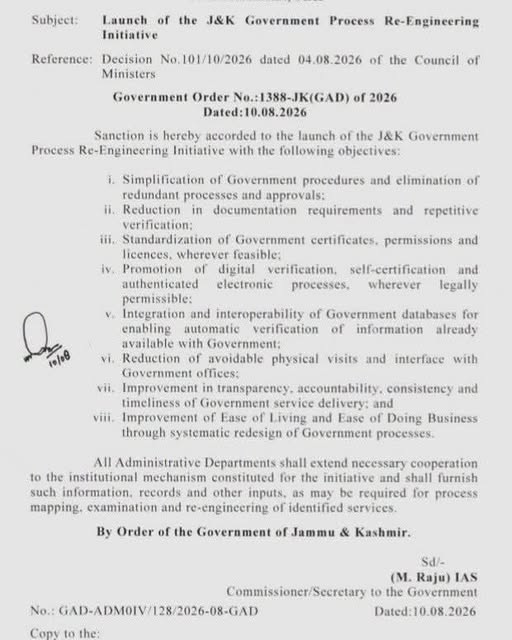
The initiative has been formally approved through Government Order No. 1388-JK(GAD) of 2026, issued by the General Administration Department (GAD) on August 10, 2026, pursuant to Council of Ministers Decision No. 101/10/2026 dated August 4, 2026.
The order represents a broad administrative reform exercise under which existing government processes are to be examined, mapped and, wherever required, redesigned to make them simpler, more efficient and more citizen-friendly.
Eight-point agenda for administrative reform
The Government has identified eight principal objectives for the initiative.
The first objective is the simplification of government procedures and elimination of redundant processes and approvals. This is intended to address unnecessary procedural layers and approvals that may delay delivery of government services.
The second objective is to bring about a reduction in documentation requirements and repetitive verification. The reform seeks to reduce the burden on citizens of repeatedly submitting the same information or undergoing verification where such information is already available with government authorities.
The third component involves the standardisation of government certificates, permissions and licences, wherever feasible. Standardised procedures and formats are expected to promote consistency and reduce variations in the manner in which similar services are processed by different offices or departments.
Greater use of digital verification and self-certification
The Government has also placed considerable emphasis on digital verification, self-certification and authenticated electronic processes, wherever these are legally permissible.
The objective is to facilitate greater reliance on electronic processes and reduce dependence on physical documentation and manual verification.
The order, however, makes the proposal subject to the applicable legal framework, indicating that self-certification and electronic procedures will be adopted wherever they are legally permissible.
Government databases to be integrated
Another significant element of the initiative is the proposed integration and interoperability of Government databases.
Under the reform, government systems are expected to be capable of automatically verifying information that is already available with the Government. This could reduce the need for citizens to furnish documents or information that government departments already possess.
The approach seeks to move the responsibility for internal verification, wherever possible, from the citizen to the government system.
Reduction in visits to government offices
The order specifically identifies the reduction of avoidable physical visits and interface with Government offices as one of the objectives of the initiative.
This is expected to have direct implications for citizens accessing government services, particularly in cases where an application, verification or approval can be completed through digital or electronically authenticated processes.
The reform is consequently aimed at reducing the time and effort spent by citizens in navigating government offices for routine services.
Institutional mechanism to oversee the reform exercise
A key provision of the order is the constitution of an institutional mechanism for the initiative.
The mechanism will require the cooperation of all Administrative Departments and will be provided with information, records and other inputs necessary for process mapping, examination and re-engineering of identified services.
This means that the exercise will involve examining the existing workflow of government services, identifying unnecessary or repetitive stages and considering how those services can be redesigned.
The order, in the text available, does not provide the names of the members of the institutional mechanism or identify a separate individual monitoring authority. Accordingly, no particular officer or committee can be named as the exclusive monitor on the basis of this order alone.
However, the General Administration Department is the issuing department and the order has been issued by M. Raju, IAS, Commissioner/Secretary to the Government, on behalf of the Government of Jammu & Kashmir. The respective Administrative Departments have been expressly directed to cooperate with the institutional mechanism.
Departments made responsible for cooperation and implementation
The order places an obligation on all Administrative Departments to extend the necessary cooperation to the institutional mechanism.
Departments have been directed to furnish the information, records and other inputs that may be required for mapping, examination and re-engineering of identified government services.
This provision is significant from the standpoint of implementation because the reform exercise will require departments to open up their existing procedures for examination and provide the institutional mechanism with the information required to identify areas for improvement.
The order thus establishes a framework in which departments are expected to participate in the review rather than independently continuing with existing processes.
Accountability and public interest at the centre of reform
Improving transparency, accountability, consistency and timeliness of government service delivery is specifically listed as one of the objectives of the initiative.
The reform is therefore not limited to reducing paperwork or digitising services. It also seeks to improve the accountability and consistency of government service delivery.
The stated objective of improving timeliness is particularly significant for citizens and businesses dependent on government approvals, certificates, permissions and licences.
Once processes are mapped and redesigned, their effectiveness will ultimately depend on the concerned departments implementing the approved changes and ensuring that the intended simplifications translate into actual improvements in service delivery.
Focus on Ease of Living and Ease of Doing Business
The Government has also connected the initiative with improving Ease of Living and Ease of Doing Business in Jammu & Kashmir.According to the order, this will be pursued through the systematic redesign of Government processes.
For citizens, this could mean fewer forms, reduced documentation, less repetitive verification and fewer unnecessary visits to government offices. For businesses, simplification and standardisation of permissions, licences and approvals could help reduce procedural delays and administrative burden.
Reform goes beyond digitisation
A notable feature of the initiative is that it focuses on re-engineering government processes, rather than simply transferring existing procedures to digital platforms.
If a procedure contains unnecessary approvals, repeated verification or avoidable documentation, merely digitising that procedure would continue to impose the same burden on the citizen.
The Government’s stated approach instead seeks to examine the process itself and determine whether unnecessary stages can be removed, information can be verified internally, documentation can be reduced and electronic processes can replace physical interaction wherever legally possible.
What the initiative could mean for citizens
If implemented effectively across departments, the initiative could lead to:
fewer unnecessary government approvals;
reduced paperwork and documentation;
less repetitive verification;
greater acceptance of self-certification where legally permissible;
increased use of digital and electronically authenticated processes;
automatic verification of information already held by government;
fewer avoidable visits to government offices;
greater standardisation of certificates, licences and permissions;
improved consistency in delivery of government services; and
greater transparency, accountability and timeliness.
GAD to coordinate government-wide reform framework
The order has been issued by the General Administration Department, which functions as the central administrative department for matters covered by the order.
The initiative, however, is intended to have a government-wide application, with all Administrative Departments required to cooperate with the institutional mechanism and provide the necessary records and inputs.
The exact service-wise changes, timelines and operational arrangements would depend on the subsequent process-mapping and re-engineering exercise and any further directions issued by the competent authorities.
A move towards citizen-centric governance
The launch of the initiative signals an attempt to shift the focus of administrative reform from individual departmental procedures towards a systematic review of how government services are designed and delivered.
By targeting redundant approvals, repetitive verification, excessive documentation and avoidable physical interaction, the Government has sought to address several of the procedural issues that can make access to public services time-consuming for citizens.
The emphasis on database interoperability and authenticated electronic processes also points towards greater reliance on government-held information and digital verification, subject to legal requirements.
Accountability will depend on implementation
While the order establishes the institutional framework and directs Administrative Departments to cooperate, the actual impact of the initiative will depend on effective monitoring of the re-engineering exercise, implementation of approved changes by departments and adherence to the simplified procedures thereafter.
The order itself does not name a separate officer or committee responsible for monitoring every implementation aspect. It instead provides for an institutional mechanism and requires all Administrative Departments to cooperate with it.
The initiative’s stated end goal is clear: a government service-delivery system that is simpler, less paperwork-intensive, digitally enabled, more transparent and accountable, and requires citizens to make fewer unnecessary visits to government offices.
See less