J&K to Map 2.22 Lakh AAY Households for Free Electricity, Push Solar and Power Reforms
||Black and White Digital News ||
||Parvinder Singh April 12,2026||
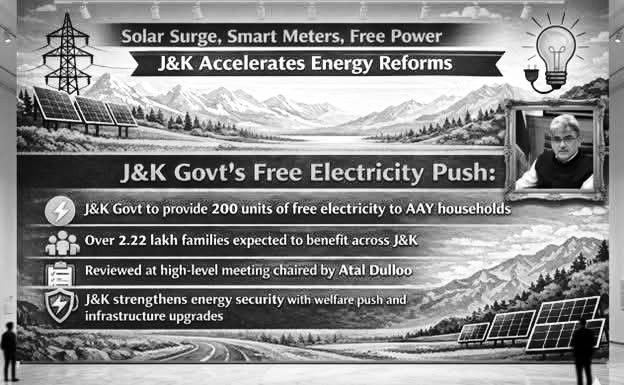
Srinagar : In a major welfare-cum-reform initiative, the Government of Jammu and Kashmir has begun identifying beneficiaries under the Antyodaya Anna Yojana (AAY) category to provide 200 units of free electricity per month to the poorest households. The move is expected to benefit over 2.22 lakh families across the Union Territory and is part of a broader strategy to combine immediate financial relief with long-term power sector reforms.
The progress of the initiative was reviewed at a high-level meeting chaired by Chief Secretary Atal Dulloo, where officials outlined efforts to ensure accurate and inclusive identification of beneficiaries. The process is being carried out in coordination with district administrations, with a focus on reaching households in remote and mountainous areas. Authorities are undertaking extensive field verification and data validation to address discrepancies between ration card records and electricity consumer databases, while also tackling issues such as migration and inaccessible households.
Officials acknowledged several implementation challenges, particularly in far-flung regions where terrain and connectivity constraints make verification and service delivery difficult. Despite these hurdles, the administration expressed confidence that a coordinated approach would ensure timely completion of the exercise while maintaining transparency and accuracy.
Alongside the welfare measure, the Union Territory is witnessing strong progress in rooftop solar adoption under the PM Surya Ghar: Muft Bijli Yojana. The programme has received significant public response, with thousands of installations already completed across both Jammu and Kashmir divisions. The initiative promotes clean energy while reducing dependence on conventional power sources and easing the burden on the grid.
A key driver of this expansion has been the Renewable Energy Service Company (RESCO) model, under which private developers install and maintain solar systems without requiring upfront investment from consumers. This approach has made solar energy more accessible, particularly for middle- and low-income households, and has accelerated the transition toward decentralized power generation.
The meeting also reviewed progress under the Revamped Distribution Sector Scheme (RDSS), which aims to modernize power infrastructure and improve efficiency. Projects worth ₹5,762 crore are currently underway, including significant investments in smart metering and loss reduction measures. Over 7.10 lakh smart meters have been installed so far, enabling real-time monitoring, improved billing accuracy, and enhanced transparency.
Officials reported measurable improvements in the sector’s performance, including a reduction in the gap between the Average Cost of Supply and Average Revenue Realised to 0.3 in 2025–26. Billing efficiency has increased to 77 percent, while collection efficiency has reached 94 percent. Aggregate Technical and Commercial losses have also declined to 30 percent, reflecting progress in strengthening the financial sustainability of the power sector.
The government’s approach integrates targeted subsidies with systemic reforms, aiming to ensure both affordability and long-term reliability of electricity supply. By combining free power for vulnerable households with investments in renewable energy and infrastructure, the administration is working toward a more inclusive and sustainable energy ecosystem.
Officials emphasized that improved access to reliable electricity will have wider socio-economic benefits, particularly in rural areas, by supporting livelihoods, enhancing public services, and improving quality of life. With continued focus on transparency, coordination, and innovation, Jammu and Kashmir’s power sector is undergoing a significant transformation aimed at achieving energy security and inclusive growth.