New Bill in Lok Sabha on Removal of J&K Ministers: Governance Reform or Misplaced Priority?
||Black and White Digital News ||
||Parvinder Singh August 20,2025 ||
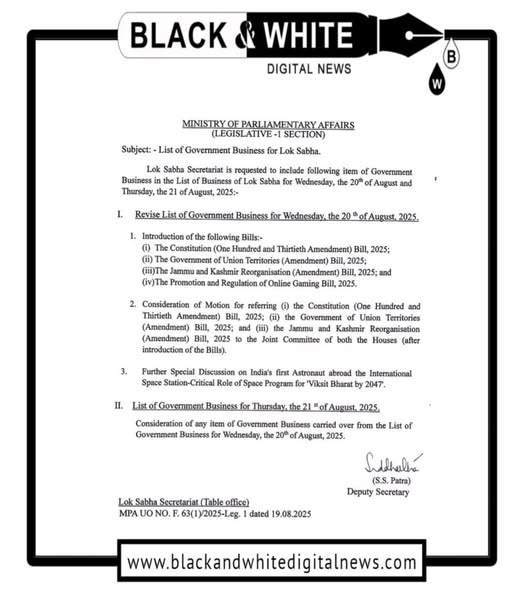
New Delhi: Union Home Minister Amit Shah on Tuesday introduced a Bill in the Lok Sabha seeking an amendment to Section 54 of the Jammu and Kashmir Reorganisation Act, 2019. The amendment proposes a clear legal framework for the removal of the Chief Minister or any Minister in Jammu and Kashmir if they are arrested and detained on charges of serious criminal offences.
The move comes six years after the abrogation of Article 370 and subsequent reorganisation of the erstwhile state, and is being seen as an attempt to tighten accountability in governance.
Why the Bill Now?
The Statement of Objects and Reasons, attached with the Bill, highlights that:
• Elected representatives must rise above political interests and act only in public welfare.
• Ministers facing grave criminal allegations can erode public trust, compromise constitutional morality, and disrupt good governance.
• Currently, there is no legal provision in the J&K Reorganisation Act to remove a minister under such circumstances.
Thus, the amendment seeks to ensure that governance in Jammu & Kashmir is not paralyzed by leaders facing serious criminal charges.
The Constitutional Angle:
Parliament has complete authority to amend the Jammu and Kashmir Reorganisation Act, since it was passed in 2019 as central legislation after the abrogation of Article 370.
Experts note that while such laws already exist in different forms for states across India, J&K’s special legislative framework required a separate amendment to explicitly cover this scenario.
“This is constitutionally valid, but politically significant,” said a constitutional expert. “It signals that New Delhi continues to hold a tight grip over J&K’s political architecture.”
The Larger Debate – Governance vs. Ground Realities
While the Bill addresses issues of political accountability, many observers argue that the timing raises larger questions about the government’s priorities:
1. Economic Slowdown: India’s economy continues to face stress with inflationary trends, high fiscal deficit, and uncertain investor confidence.
2. Unemployment: J&K’s unemployment rate remains one of the highest in the country. Despite promises post-2019 of massive investment and job creation, private industry has been reluctant to commit.
3. Market Instability: Small businesses and traders complain of shrinking demand and unstable markets. Many argue that the focus should be on economic revival packages rather than administrative tightening.
4. Common Man’s Struggles: Rising prices of essentials, limited livelihood opportunities, and lack of welfare support have deepened frustration among ordinary citizens.
Political Significance
• For the Centre: The Bill strengthens its narrative of “clean governance” in J&K. It signals that no minister facing serious criminal cases will be allowed to remain in office.
• For Critics: Opposition parties and civil society activists are expected to argue that the government is more focused on consolidating political power in J&K than addressing unemployment, economic distress, and social challenges.
“This Bill might improve governance on paper, but will it put food on the table of the unemployed youth in Kashmir or Jammu? That is the real question,” a political analyst noted.
The Bill represents an effort to plug legal loopholes in the governance structure of Jammu and Kashmir. However, at a time when economic instability, unemployment, and social distress dominate the lives of common citizens, the move may be criticized as another example of political control taking precedence over public welfare.
Whether this amendment strengthens democracy in J&K or diverts attention from pressing ground realities remains to be seen.