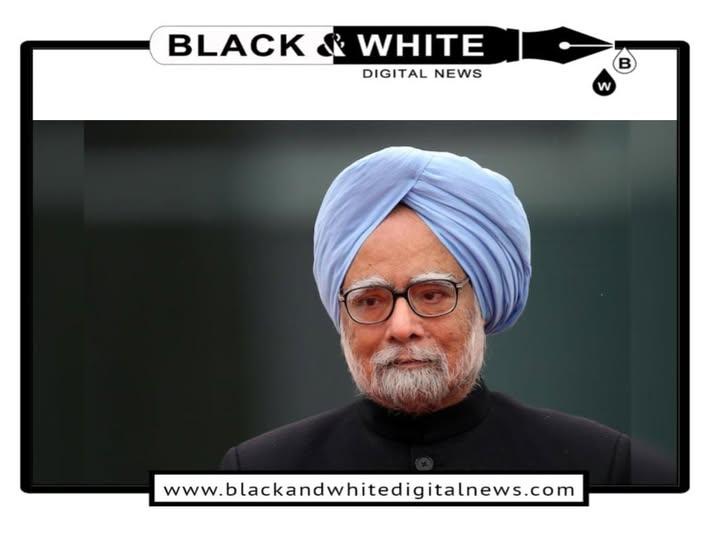
Manmohan Singh: The Silent Reformer Who Shaped Modern India Passes Away at 92.
||Black and White Digital News||
||Tejveer Singh December 26, 2024||
New Delhi: India mourns the loss of one of its most distinguished leaders, former Prime Minister Dr. Manmohan Singh, who passed away at the age of 92. A visionary economist, an astute policymaker, and a humble leader, Singh breathed his last at AIIMS Delhi on Thursday evening. His demise marks the end of an era that witnessed India’s transformation into a global economic powerhouse.
A Life of Humble Beginnings and Academic Brilliance:
Born on September 26, 1932, in a village in the Punjab province of undivided India, Manmohan Singh’s journey from modest beginnings to the apex of Indian politics is nothing short of extraordinary. Completing his matriculation from Punjab University in 1948, he went on to earn a First Class Honours degree in Economics from the University of Cambridge in 1957 and later a D.Phil in Economics from Nuffield College, Oxford, in 1962.
His academic prowess was evident in his critique of India’s inward-oriented trade policies through his seminal work, “India’s Export Trends and Prospects for Self-Sustained Growth”. Singh also enriched academic institutions like Punjab University and the Delhi School of Economics with his contributions.
An Administrator Par Excellence:
Singh’s administrative acumen shone brightly during his tenure in pivotal roles. Joining the Indian government in 1971 as an economic advisor, he rose to become the Chief Economic Advisor in 1972. Over the years, he served as Secretary in the Ministry of Finance, Deputy Chairman of the Planning Commission, and Governor of the Reserve Bank of India (RBI).
His international roles included being Secretary General of the South Commission in Geneva and a stint at the UNCTAD Secretariat. These experiences shaped his global outlook and enriched his contributions to India’s economic policies.
The Architect of Economic Reforms:
Singh’s tenure as Finance Minister between 1991 and 1996 under the Narasimha Rao government was a watershed moment in India’s history. As the country grappled with a severe economic crisis, Singh spearheaded bold reforms that liberalized the Indian economy, dismantling decades of socialist policies. His leadership is credited with opening India to global markets, stabilizing its economy, and fostering a path toward sustained growth.
Prime Ministerial Legacy:
Sworn in as Prime Minister on May 22, 2004, Singh served two consecutive terms, leaving an indelible mark on the nation. His government introduced transformative policies like the Mahatma Gandhi National Rural Employment Guarantee Act (MGNREGA), providing wage employment to rural households, and the Right to Information Act, empowering citizens with transparency in governance.
Under his leadership, the National Food Security Act was launched in 2013, ensuring subsidized food grains to two-thirds of India’s population. These landmark initiatives cemented his reputation as a leader deeply committed to inclusive growth.
A Statesman on the Global Stage:
Singh represented India with distinction on international platforms, leading delegations to the Commonwealth Heads of Government Meeting in Cyprus and the World Conference on Human Rights in Vienna in 1993. His calm demeanor and sharp intellect earned him respect on the global stage, enhancing India’s stature.
Awards and Honours:
Recognizing his unparalleled contributions, Singh was conferred with the Padma Vibhushan, India’s second-highest civilian honor, in 1987. This accolade was among many that celebrated his service to the nation.
A Humble Giant Remembered:
Retiring from the Rajya Sabha in April 2024, Singh remained a revered figure in Indian politics and public life. His silence often spoke louder than words, epitomizing dignity, integrity, and unwavering dedication to India’s progress.
As India bids farewell to the architect of its economic resurgence, his legacy continues to inspire generations. Dr. Manmohan Singh’s life exemplifies how intellect, humility, and perseverance can transform a nation. His journey from a small village in Punjab to the highest office in the land will forever be etched in the annals of history.