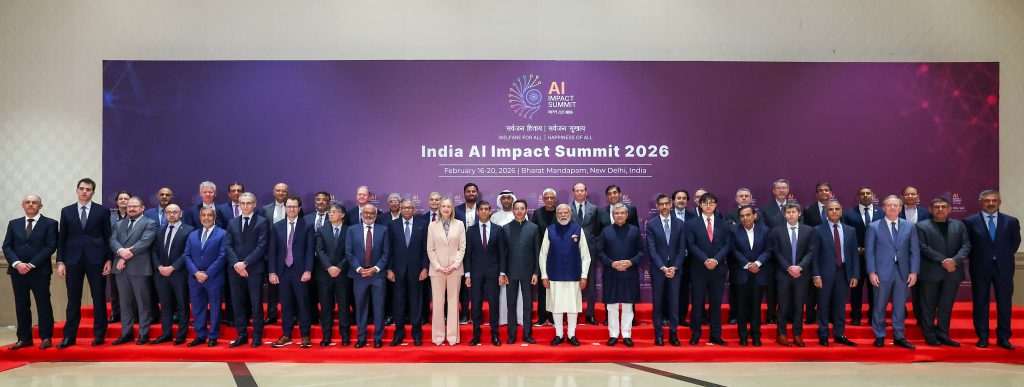
Global Tech Leaders Urge Democratic, Inclusive AI To Serve Global South At India AI Summit 2026

Leading figures from the technology and philanthropy sectors on Thursday called for the democratization and inclusive development of artificial intelligence to prevent deepening global divides and to deliver broad prosperity, particularly in the Global South, during keynote addresses at the India AI Impact Summit 2026 in New Delhi.
The summit, inaugurated earlier in the day by Prime Minister Narendra Modi who stressed that AI must serve as a tool for inclusion and empowerment in developing regions featuring a series of high-profile interventions that built on one another to highlight both AI’s accelerating potential and the responsibility to guide it equitably.
Sam Altman, CEO of OpenAI, opened the discussion by pointing to the extraordinary speed of progress and India’s growing influence in shaping AI’s future. “On our current trajectory, we believe we may be only a couple of years away from early versions of true super intelligence,” he said. “If we are right, by the end of 2028, more of the world’s intellectual capacity could reside inside of data centers than outside of it.” Altman argued that openness is essential for safety and fairness, declaring that “democratization of AI is the only fair and safe path forward” and “the best way to ensure that humanity flourishes.”
Building on that theme, Brad Smith, Vice Chair and President of Microsoft, framed AI as the defining technology of the century for either narrowing or widening the global economic and technological gap. “AI, perhaps more than any other technology this century, will play a decisive role in either closing this economic divide or exacerbating it,” he stated. “That is the single most important question for us today: How can we do better?” Smith stressed that infrastructure investment, widespread skilling, and support for linguistic diversity are non-negotiable if AI is to benefit the Global South and translate into shared, sustainable prosperity.
Ankur Vora, President of the Africa and India Offices at the Gates Foundation, shifted the focus to tangible human impact. He noted the contrasting predictions about AI’s future — some see it lifting everyone, others fear it will only enrich the already privileged — but insisted the outcome is not inevitable. “But the fact is, it’s not a matter of prediction. It’s a choice,” Vora said. Announcing new philanthropic initiatives, he defined the ultimate test of AI as “whether it tangibly improves lives across communities that have historically been left behind,” especially in health, education, and agriculture.
Julie Sweet, Chair and CEO of Accenture, closed the sequence by calling for active reinvention across every sector. “Using AI as an engine for growth is the only path for global prosperity, for all,” she asserted. Sweet emphasised that long-term success depends on strong leadership, agreed global standards, comprehensive workforce transformation, and an unwavering commitment to keeping humans in control while AI powers economic expansion.
Together, the addresses painted a consistent picture: while AI is advancing at an unprecedented pace, its benefits will only reach everyone if guided by deliberate choices toward openness, inclusion, responsibility, and cooperation. The speakers converged on the view that AI must close gaps rather than widen them, expand opportunity rather than concentrate power, and remain anchored in human values, democratic principles, and purposeful global leadership.