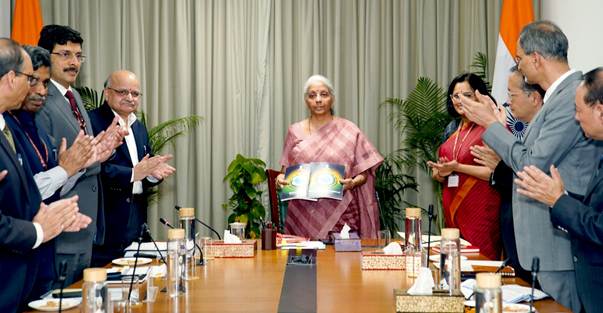
Finance Minister Sitharaman Launches National Monetisation Pipeline 2.0, Estimates ₹16.72 Trillion Asset Potential

Union Finance Minister Nirmala Sitharaman on Monday launched the second phase of the National Monetisation Pipeline, or NMP 2.0, outlining an estimated asset monetisation potential of ₹16.72 lakh crore over the five-year period from FY 2026 to FY 2030, according to a statement issued by NITI Aayog. The second phase of the asset monetisation pipeline for Central ministries and public sector entities has been developed by NITI Aayog in consultation with infrastructure line ministries, based on the mandate for the ‘Asset Monetisation Plan 2025–30’ announced in the Union Budget 2025–26. NMP 2.0 estimates an aggregate monetisation potential of ₹16.72 lakh crore, including private sector investment of ₹5.8 lakh crore under the asset monetisation pipeline of Central ministries and public sector entities over the five-year period.
The pipeline was released in the presence of the Chief Executive Officer of NITI Aayog and Secretaries of infrastructure line ministries covered under the programme — Road Transport and Highways, Railways, Power, Petroleum and Natural Gas, Civil Aviation, Ports, Shipping and Waterways, Telecommunications, Tourism, Food and Public Distribution, Mining, Coal, and Housing and Urban Affairs — along with the Secretary of the Ministry of Finance, the Secretary (Law), and the Chief Economic Adviser. Addressing the launch, the Finance Minister complimented ministries and departments of the government and NITI Aayog for achieving nearly 90% of the ₹6 lakh crore target set for four years under the first phase of the National Monetisation Pipeline, or NMP 1.0.
She said NMP 2.0 is aligned with the mission of achieving Viksit Bharat through accelerated infrastructure development and has the potential to fuel the country’s growth momentum. The Finance Minister noted that NMP 1.0 was the first asset monetisation pipeline of its kind at a large scale and said best practices learned should be leveraged in NMP 2.0. She underscored that learnings and experiences from NMP 1.0 would guide the optimisation of resources and opportunities to achieve results in a time-bound manner and exhorted all departments to focus on process simplification and standardisation so that monetisation becomes a seamless experience.
Sitharaman said the five-year asset monetisation target of ₹16.7 lakh crore under NMP 2.0 is ambitious and more than 2.6 times higher than that under NMP 1.0, and added that ministries and departments must aim to surpass the indicated targets through proactive efforts. Highlighting the significance of asset monetisation, she said the programme enables recycling of productive public assets, unlocking resources for reinvestment in new projects and capital expenditure, and facilitates efficient mobilisation of funds for public asset CAPEX while minimising budgetary outgo.
NMP 2.0 is the culmination of insights, feedback and experiences consolidated through multi-stakeholder consultations undertaken by NITI Aayog, the Ministry of Finance and line ministries, with several rounds of discussions held with stakeholders, making it a whole-of-government initiative. An empowered Core Group of Secretaries on Asset Monetisation, chaired by the Cabinet Secretary, will continue to monitor the progress of the programme, and the government said it is committed to making asset monetisation a value-accretive proposition for both the public sector and private investors and developers through improved infrastructure quality and operations and maintenance.
The Union Budget 2025–26 identified monetisation of operating public infrastructure assets as a key means of sustainable infrastructure financing and provided for preparation of the National Monetisation Pipeline 2.0, following which NITI Aayog prepared the report in consultation with infrastructure line ministries. NMP 2.0 provides a medium-term roadmap for public asset owners along with visibility of potential assets for the private sector and is structured as a guidance document detailing the methodology and roadmap for monetisation. The framework broadly follows the asset monetisation concept laid out in NMP 1.0, comprising transfer of assets for a limited period, divestment of portions of listed entities to unlock capital, securitisation of cash flows and strategic commercial auctions.
Proceeds from monetisation projects will be allocated under four heads depending on the implementing agency and mode of monetisation: revenues from projects implemented by Central ministries will flow to the Consolidated Fund of India; proceeds from monetisation by public sector undertakings and major port authorities will accrue to the concerned entities; revenues such as royalties from certain projects, particularly in mining and coal sectors, will accrue to State Consolidated Funds; and private sector investment will be recorded under direct investment for projects involving construction and major maintenance.
The aggregate asset pipeline under NMP 2.0 for FY 2026–30 is indicatively valued at ₹16.72 lakh crore, including private sector investment of ₹5.8 lakh crore, with sectors covered including highways, multimodal logistics parks and ropeways at ₹4.42 lakh crore, railways ₹2.62 lakh crore, power ₹2.76 lakh crore, petroleum and natural gas ₹16,300 crore, civil aviation ₹27,500 crore, ports ₹2.63 lakh crore, warehousing and storage ₹10,000 crore, urban infrastructure ₹52,000 crore, coal ₹2.16 lakh crore, mines ₹1 lakh crore, telecom ₹4,800 crore and tourism ₹1,200 crore. Annual phasing of total monetisation value is estimated at ₹2,49,493 crore in FY26, ₹3,26,435 crore in FY27, ₹3,46,312 crore in FY28, ₹3,68,852 crore in FY29 and ₹3,81,208 crore in FY30.
It is estimated that the largest portion of proceeds under NMP 2.0 will accrue to the Consolidated Fund of India, followed by direct private investment, PSU or Port Authority allocation and State Consolidated Funds. Assets and transactions under the programme are expected to be rolled out through instruments including public-private partnership concessions and capital market instruments such as Infrastructure Investment Trusts, with the choice of instrument depending on sector, asset characteristics, timing, investor profile and the level of operational or investment control retained by the asset owner. The monetisation potential values assessed under NMP 2.0 are indicative and subject to variation at the time of actual transactions.