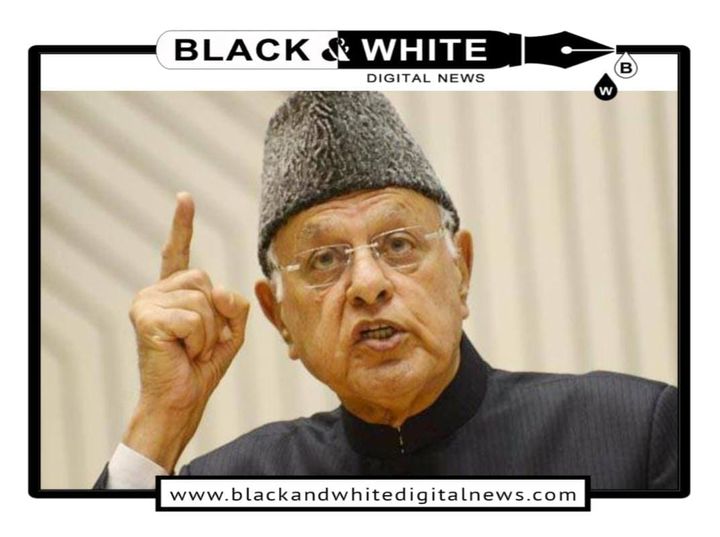
Farooq Abdullah Stresses Unity, Urges an End to Blame Games Amid Political Tensions in J&K.
Farooq to Mufti: Blaming each other will get us nowhere.
||Black and White Digital News||
||September 01,2024||
Srinagar : National Conference (NC) President Dr. Farooq Abdullah on Saturday issued a strong call for unity and mutual respect, urging political leaders in Jammu and Kashmir to stop engaging in divisive rhetoric and focus on safeguarding the nation’s future. His comments came in response to People’s Democratic Party (PDP) President Mehbooba Mufti’s remarks accusing the NC of hypocrisy, claiming that elections are “Haram” (forbidden) for them when losing but “Halal” (permissible) when winning.
Speaking to reporters after offering prayers at the revered Sheikh Hamza Makhdoom (RA) shrine in Srinagar, Dr. Abdullah avoided engaging directly with Mufti’s claims but stressed the futility of finger-pointing in these critical times. “I will not say anything about her. May God bless her, and may she follow her own path, but we should focus on protecting the country,” he said, urging political unity over public accusations.
The seasoned leader emphasized that political leaders need to rise above petty squabbles and focus on the larger issues facing Jammu and Kashmir and the nation. Abdullah’s remarks appeared to echo a growing concern that the divisive politics plaguing the state is detracting from the real challenges the region faces—challenges that require unity and a forward-looking approach.
Dr. Abdullah’s comments also touched upon the broader national political discourse when asked about the Assam government’s controversial decision to cancel the two-hour Namaz break for Muslim legislators. Abdullah firmly reiterated that India’s strength lies in its “unity in diversity” and that any actions that undermine religious harmony must be approached with caution. “India, with its federal structure, must safeguard the religious and cultural diversity across states, from Tamil Nadu to Kashmir, Bengal to Maharashtra,” he said.
In an era where religious and cultural tensions are becoming more prevalent across various states, Abdullah emphasized that governments should uphold the values of pluralism that have long defined India. He suggested that such decisions could harm the spirit of unity and inclusivity that India, as a nation, should strive to protect.
Echoing his earlier statements, Abdullah expressed optimism for the future, predicting that the political landscape would evolve positively. “Nothing is permanent. Things will change in time, and good things will prevail again. We will inform them that such activities should not be indulged in when our government comes to power,” he said, indicating that these issues would be rectified under NC leadership.
The former Jammu and Kashmir chief minister did not shy away from addressing the state’s inter-religious dynamics either, particularly the need to foster respect for all communities. He highlighted that when positive relations are cultivated within Jammu and Kashmir, the effects ripple across the entire country, making the argument for inclusivity stronger than ever. “When our approach toward others is good, it will reflect positively across the country. This attitude must be embraced by everyone,” he stressed.
In an important political shift, Abdullah also welcomed former members of Jamaat-e-Islami contesting in the upcoming elections. Their participation in the democratic process, he argued, was a significant step toward strengthening democracy in the region. “This is a positive step and should be encouraged. Their participation is a good sign for the democratic process,” he added, offering congratulations to those who have transitioned from militant backgrounds to engaging in political life.
Abdullah’s remarks come at a time when Jammu and Kashmir’s political climate remains tense, with upcoming elections sparking fierce debate among the state’s leading political factions. In his statements, the NC President appeared to position himself as a stabilizing force, one advocating for a shift away from the blame games that dominate the political discourse and toward a focus on preserving unity, fostering tolerance, and safeguarding democracy in Jammu and Kashmir.