DGPC Jammu Demands Ban on ‘Emergency’ Movie Screening, Citing Risks to Communal Harmony and Public Order
||Black and White Digital News ||
||Parvinder Singh August 29,2024 ||
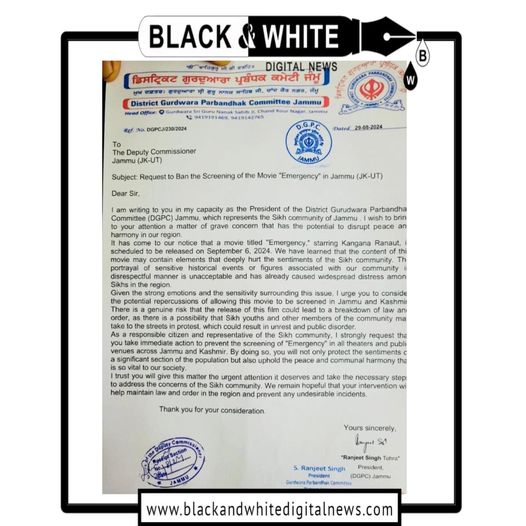
Jammu: In a significant development, the District Gurdwara Parbandhak Committee (DGPC) Jammu has formally requested the Deputy Commissioner of Jammu (JK-UT) to ban the screening of the upcoming movie *”Emergency,”* directed by and starring Kangana Ranaut. Scheduled for release on September 6, 2024, the film has raised concerns within the Sikh community regarding its portrayal of sensitive historical events and figures.
In a letter dated August 29, 2024, S. Ranjeet Singh Tohra, President of DGPC Jammu, expressed grave concerns that the movie contains content that could deeply hurt the sentiments of the Sikh community. The DGPC believes that the portrayal of certain events related to the Emergency period (1975-1977) might be disrespectful to Sikh figures, potentially causing widespread distress among the community.
Risks to Communal Harmony:
The DGPC has emphasized the potential repercussions of allowing the film to be screened in Jammu and Kashmir, warning that it could lead to a breakdown of law and order. The letter highlights the possibility of Sikh youths and other members of the community taking to the streets in protest, which could escalate into unrest and public disorder. The committee fears that the screening of the movie could disrupt the fragile peace and communal harmony in the region, which has a history of sensitive communal dynamics.
Call for Immediate Action:
The DGPC has urged the Deputy Commissioner to take immediate action to prevent the screening of *”Emergency”* in all theaters and public venues across Jammu and Kashmir. The committee argues that such a measure is necessary not only to protect the sentiments of the Sikh community but also to uphold the peace and prevent any undesirable incidents that could result from the movie’s release.
Historical and Social Context:
*”Emergency”* is expected to depict events from one of the most controversial periods in India’s history. The Emergency, declared by then-Prime Minister Indira Gandhi, was marked by political turmoil, censorship, and the suspension of civil liberties. The Sikh community, which has faced its own historical challenges, views the portrayal of certain aspects of this period with caution, fearing that it could reopen old wounds or be perceived as an affront to their historical narrative.
Potential Legal and Ethical Implications:
The request from DGPC Jammu raises important legal and ethical questions about the balance between freedom of expression and the need to protect communal harmony. While the Indian Constitution guarantees freedom of speech, this right can be restricted in the interest of public order. The authorities must now carefully consider whether the content of the movie justifies such a restriction or if alternative measures can be taken to mitigate potential unrest.
The administration’s response to this request will likely set a precedent for how similar situations are handled in the future. If the movie is banned, it could signal a heightened sensitivity to communal concerns at the cost of artistic expression. If it is allowed to screen, the authorities will need to prepare for potential protests and ensure that law and order is maintained.
In conclusion, the DGPC Jammu’s call for a ban on *”Emergency”* highlights the ongoing tension between artistic freedom and community sensitivities in India. The situation underscores the importance of careful consideration and dialogue in addressing such issues, particularly in a region as complex as Jammu and Kashmir. The decision taken by the authorities will be closely watched and will have significant implications for both the Sikh community and the broader public.