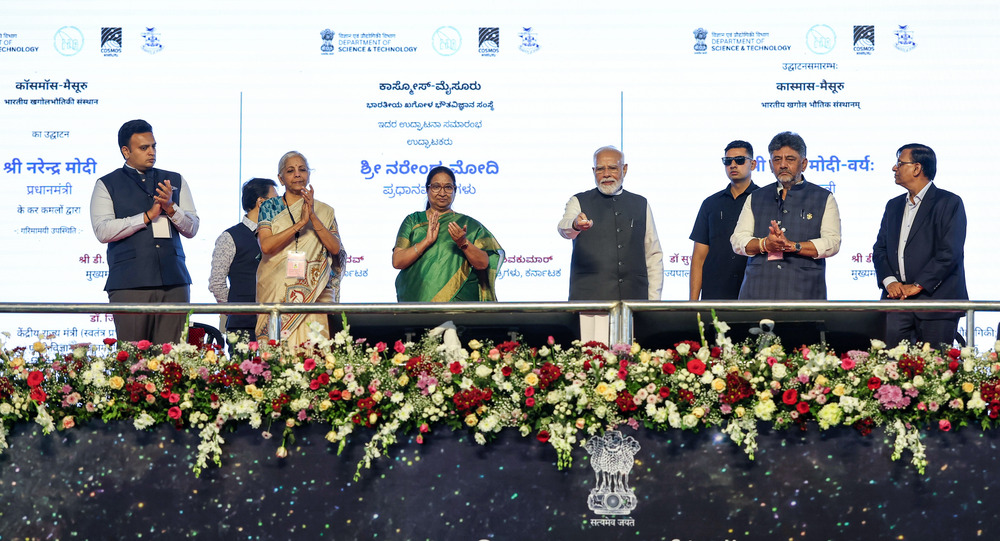
PM Modi Inaugurates India’s First LED Dome Planetarium In Mysuru

Prime Minister Narendra Modi on Friday inaugurated COSMOS-Mysuru Planetarium, India’s first LED dome planetarium, in Mysuru, Karnataka, and described it as a significant addition to the country’s scientific and educational infrastructure.
Addressing the gathering, PM Modi greeted the people in Kannada and expressed happiness over returning to Mysuru to dedicate the planetarium to the nation, months after inaugurating the Viveka Smaraka. Drawing a parallel between the two landmarks, he said that while the Viveka Smaraka encourages introspection and spiritual pursuits, the COSMOS Planetarium inspires people to explore the mysteries of the universe.
“This is an example of the fact that in India, the traditions of spirituality and science have always moved forward together,” he said.
Recalling India’s rich astronomical heritage, the Prime Minister highlighted the contributions of ancient Indian scholars, including Aryabhata, Varahamihira, Bhaskaracharya and Nilakantha Somayaji, who studied celestial movements, developed calendars and calculated solar and lunar eclipses without access to modern instruments and technology.
PM Modi also highlighted Mysuru’s contribution to the country’s educational and scientific development, recalling the establishment of the University of Mysore under Maharaja Nalwadi Krishnaraja Wadiyar and the Wadiyar royal family’s role in laying the foundation of the Indian Institute of Science in Bengaluru.
He said the new planetarium would add another chapter to Mysuru’s legacy of promoting knowledge and scientific learning. Describing his experience of watching a show inside the LED dome as wonderful, he congratulated the institutions and officials involved in the project, including the Indian Institute of Astrophysics and the University of Mysore.
Tracing India’s scientific progress, PM Modi referred to the evolution of the national slogan from ‘Jai Jawan, Jai Kisan’ to ‘Jai Vigyan’, introduced by former Prime Minister Atal Bihari Vajpayee, and subsequently to ‘Jai Anusandhan’, which he said reflects India’s research and innovation ambitions.
Highlighting the achievements of Indian students in international science competitions, he recalled the country’s performance at the International Olympiad on Astronomy and Astrophysics. Five Indian students participated in this year’s edition in Vietnam, with four winning gold medals and one securing silver.
He also cited the achievements of young Indians at international Olympiads in Mathematics, Physics, Chemistry and Biology, saying that students could achieve extraordinary results when provided with access to quality education, technology, resources and institutional support. The COSMOS Planetarium, he said, would help nurture their scientific ambitions.
Emphasising the need to keep pace with rapid technological advancements, the Prime Minister outlined India’s progress in astronomy, astrophysics and space exploration over the past decade. He cited the Chandrayaan-3 mission, which made India the first country to land near the Moon’s south pole, and the launch of Aditya-L1, India’s first space-based solar observatory.
He also recalled India’s achievement in demonstrating space docking and undocking capabilities, making it the fourth country to accomplish the feat, and referred to an Indian astronaut’s recent visit to the International Space Station. The experience and knowledge gained from the mission, he said, would contribute to India’s human spaceflight programme, Gaganyaan.
PM Modi said the opening of the space sector to private participation had created opportunities for startups and young entrepreneurs to develop rockets, launch satellites and undertake new space-related ventures. He described the growing participation of private players as a reflection of the scientific outlook of a New India, where innovation and technological development are being encouraged.
Underscoring India’s commitment to the principle of ‘Humanity First’, the Prime Minister highlighted the use of space technology for public welfare. He cited an ISRO-developed satellite communication system that enables authorities to send timely weather alerts to fishermen and track fishing boats equipped with receivers to facilitate their safe return during storms.
He also referred to the Real-Time Train Tracking System, developed by Indian Railways in collaboration with ISRO, which provides information on train locations. Satellite data, along with field-level inputs, is also being used under the Pradhan Mantri Fasal Bima Yojana to estimate crop yields and facilitate the settlement of insurance claims.
“Today our satellites are touching the heights of space, and at the same time, they are being used to make the lives of people better on Earth,” he said.
Highlighting the government’s focus on ‘Science for Society’, PM Modi said more than one crore students had benefited from over 10,000 Atal Tinkering Labs across the country. These laboratories provide students with opportunities to develop ideas, conduct experiments and pursue innovation, he added.
The Prime Minister also highlighted the ‘One Nation One Subscription’ initiative, which enables educational and research institutions to access leading international scientific journals, and the establishment of the Anusandhan National Research Foundation to strengthen the country’s research ecosystem.
Referring to the launch of the Rs 1 lakh crore Research, Development and Innovation Scheme last year, PM Modi said the initiative was aimed at ensuring sustained financial support for domestic researchers and helping translate laboratory innovations into practical applications.
Concluding his address, the Prime Minister said planetariums and science centres played an important role in nurturing curiosity among young people and strengthening India’s scientific ecosystem. He urged those associated with COSMOS to regularly organise visits for school and college students from across the region.
He expressed hope that children visiting the planetarium to learn about the universe would eventually return as scientists and share their own discoveries.
“This alone will be the biggest success of this COSMOS Planetarium,” he said.