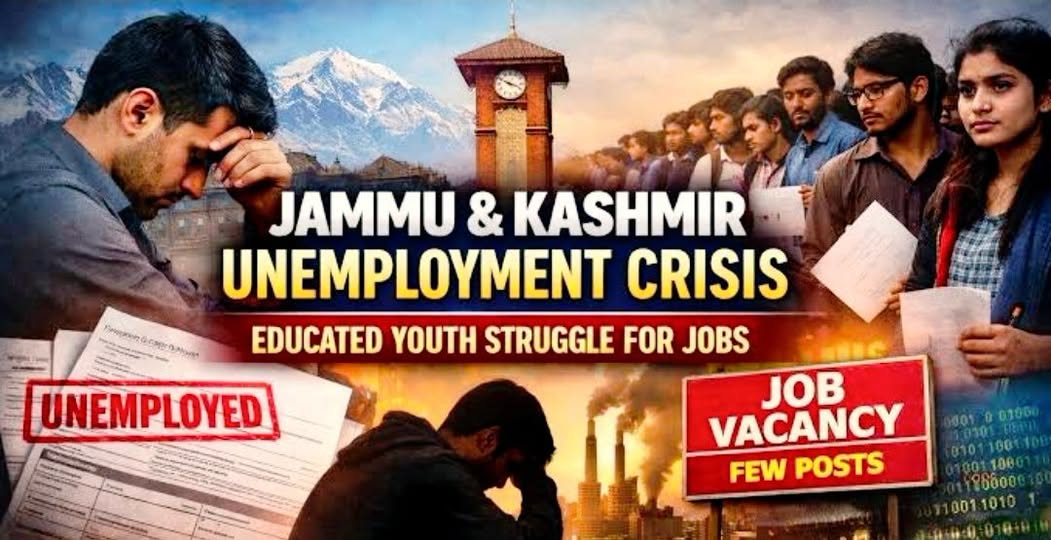
J&K’s Job Crisis Deepens: Unemployment Nearly Double National Average, 4.73 Lakh Willing to Work
||Black and White Digital News ||
||Parvinder Singh Sept 25 ,2026||
SRINAGAR : Jammu and Kashmir’s employment situation has come under renewed scrutiny with government data showing that the Union Territory’s unemployment rate has reached 6.7 per cent, almost twice the national average of 3.5 per cent, even as a government baseline survey has identified 4.73 lakh people who reported that they were not working but were willing to work.
The figures, placed before the Jammu and Kashmir Legislative Assembly, have once again brought the growing employment challenge facing the Union Territory’s youth to the centre of public debate. According to the Periodic Labour Force Survey data cited by the government, the unemployment rate among people aged 15 years and above stood at 6.7 per cent in J&K in 2024–25, compared with 3.5 per cent across India. The rate in J&K had stood at 6.1 per cent in 2023–24 and 4.4 per cent in 2022–23, indicating that the gap with the national average has persisted over recent years.
The headline unemployment figure, however, represents people who are part of the labour force and are without work but seeking or available for employment. It should therefore not be interpreted as meaning that 6.7 per cent of the entire population of J&K is unemployed.
A separate baseline survey conducted under Mission YUVA has provided another indication of the scale of the employment challenge. According to the government data, 4,73,936 people out of around 64.8 lakh surveyed in the 18–60 age group reported that they were “not working but willing to work”. The survey was conducted in January 2025 by the Employment Department in collaboration with the district administrations.
The educational profile of those identified in the survey is particularly significant. It included 70,428 postgraduates, 98,466 graduates and 1,26,059 people educated up to the higher-secondary level. Another 95,914 had secondary-level education and 44,908 had studied up to the middle level. The figures also included people with lower levels of formal education and 24,594 persons classified as illiterate.
The data raises questions not only about the availability of jobs but also about the ability of the existing economy to absorb an increasingly educated workforce. A separate Mission YUVA baseline report had earlier placed youth unemployment in J&K at 17.4 per cent, compared with 10.2 per cent nationally, although this is a different measure from the overall PLFS unemployment rate and should not be treated as interchangeable with the 6.7 per cent figure.
The employment crisis is unfolding alongside a substantial number of vacant government posts. Recent figures presented in the Assembly put the number of vacancies under the direct recruitment quota at more than 40,000, with 3,318 Gazetted, 24,427 Non-Gazetted and 12,927 Multi-Tasking Staff posts reported vacant. The Health and Medical Education Department alone accounts for 12,797 vacancies, while the Agriculture Production, Animal/Sheep Husbandry and Horticulture sector has 4,939 vacancies.
The existence of vacancies does not automatically mean that all of them can be filled immediately, as recruitment depends on sanctioned posts, service rules, recruitment procedures and other administrative requirements. Nevertheless, the scale of the vacancies has intensified questions among job seekers about the pace at which eligible posts are being referred to recruitment agencies and ultimately filled.
The government has pointed to Mission YUVA, entrepreneurship, skilling and self-employment as key components of its response. According to figures placed before the Assembly, more than 1.71 lakh youth have registered under Mission YUVA, around 70,000 formal enterprise applications have been received, nearly 52,875 detailed project reports prepared and 16,741 applications have secured bank sanctions. The government has said that sanctions were close to Rs 1,000 crore, with more than Rs 700 crore disbursed.
The critical question now is whether these initiatives are translating into sustainable employment and viable enterprises on the ground. Registration, applications, sanctions and disbursement are important administrative indicators, but for unemployed youth the ultimate measure is whether these programmes result in functioning businesses, stable incomes and durable employment.
The latest figures also put the spotlight on the political leadership of the Union Territory. The concerned minister faces questions over what concrete, time-bound strategy the government has to bring down the unemployment rate, how many of the people identified under the Mission YUVA survey have since found employment or established enterprises, and what timeline has been fixed for filling the thousands of vacant posts.
The government also needs to clarify how many of the vacant positions are presently ready for recruitment, how many have been referred to the Jammu and Kashmir Public Service Commission or other recruiting agencies, and where delays are occurring in the recruitment process.
At the same time, the Leader of Opposition and opposition legislators face questions over their follow-up on an issue that directly affects a large section of the electorate. If elected representatives are aware of the unemployment figures and the existence of thousands of vacant posts, what concrete steps have they taken inside and outside the Assembly to press for recruitment, employment generation and accountability?
Will the opposition demand a time-bound review of vacant posts and Mission YUVA outcomes, and will MLAs seek department-wise and district-wise employment data from the government?
The issue of educated unemployment also requires greater clarity. Figures such as the often-cited 46 per cent unemployment among educated youth need to be accompanied by a clear definition, age group, education category and methodology before being directly compared with the PLFS unemployment rate. Different surveys measure different aspects of the labour market, and combining them without explaining their methodology can create confusion.
For the government, opposition and elected representatives alike, the latest reports therefore present an issue that goes beyond political statements. The numbers point to a labour market under considerable pressure, with thousands of people seeking opportunities while a large number of government posts remain vacant.
The Assembly disclosures should serve as an eye-opener and prompt sustained follow-up rather than becoming another set of statistics on record. Young people preparing for competitive examinations, graduates searching for private-sector employment and aspiring entrepreneurs all need measurable answers about where new employment opportunities will come from.
The concerned minister must now explain what measurable targets have been fixed, how progress will be monitored and when the public can expect visible results. The Leader of Opposition and MLAs, meanwhile, need to demonstrate through Assembly interventions and constituency-level follow-up that unemployment is being treated as a continuing public issue rather than an occasional political talking point.
With unemployment in J&K remaining substantially above the national average, the central question confronting the administration and political leadership is straightforward: how quickly can the gap between those willing to work and the availability of meaningful, sustainable employment be narrowed?
For thousands of young people across Jammu and Kashmir, the answer cannot remain confined to surveys, announcements and recruitment promises. They are waiting for jobs, livelihoods and a clear account of what is being done to create them.