Vibrant Villages Programme: Building Stronger, More Connected Communities Along India’s Frontiers


India’s border villages are increasingly being viewed not merely as remote settlements at the edge of the country but as an important part of its security and development architecture, with the Vibrant Villages Programme (VVP) seeking to transform frontier communities through better connectivity, infrastructure, livelihoods and access to government services.
Launched in 2023, the programme aims to create vibrant, resilient and prosperous communities along India’s international land borders. Implemented in two phases, VVP-I and VVP-II, it has a combined outlay of ₹11,639 crore and seeks to cover more than 2,600 villages across the country’s land frontier.
The programme marks a shift in the government’s approach to border settlements, treating them as India’s “first villages” rather than its last. The underlying objective is that well-connected and economically active communities can contribute to both local development and border security.
India shares more than 15,000 km of international land borders with seven neighbouring countries. The Bangladesh border is the longest at 4,096.7 km, followed by China at 3,488 km and Pakistan at 3,323 km. The remaining stretches are shared with Nepal, Myanmar, Bhutan and Afghanistan.
For decades, difficult terrain, inadequate infrastructure and limited economic opportunities left many border villages isolated. The resulting out-migration contributed to depopulation in several frontier areas. VVP seeks to address these challenges by improving living conditions while creating reasons for residents to remain in, and return to, their villages.
Two phases, one frontier mission
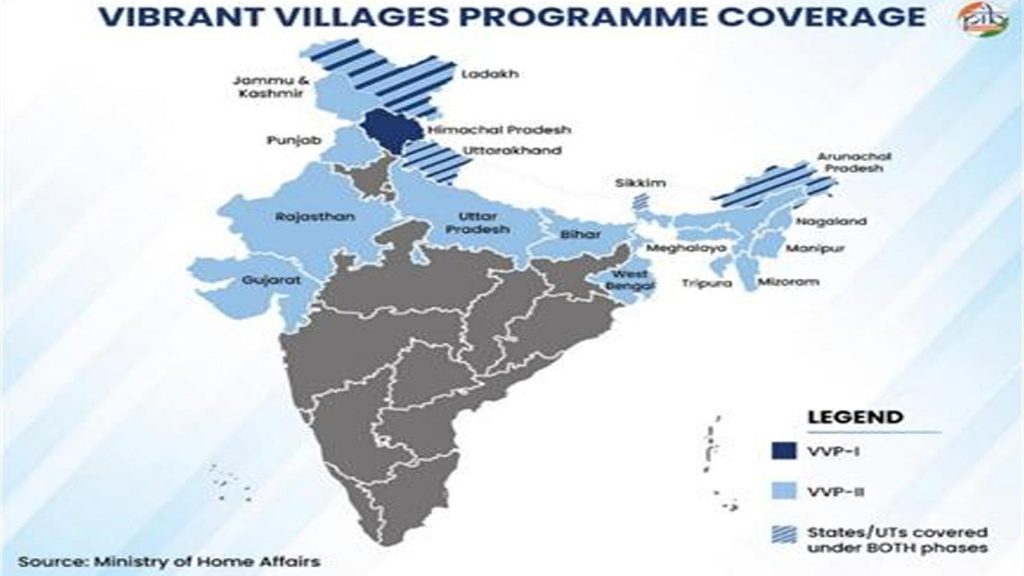
VVP-I, approved with an outlay of ₹4,800 crore for 2022-23 to 2026-27, focuses on strategically important villages along India’s northern borders. It covers 662 priority villages in 46 blocks across Arunachal Pradesh, Himachal Pradesh, Sikkim, Uttarakhand and Ladakh, with a population of around 1.42 lakh. Of the total allocation, ₹2,500 crore has been earmarked for road connectivity.
The first phase was launched at Kibithoo in Arunachal Pradesh’s Anjaw district on April 10, 2023. The strategically located village, which witnessed fighting during the 1962 India-China war, was chosen to underline the importance of bringing development to remote frontier areas.
VVP-I focuses on all-weather roads, drinking water, reliable electricity, mobile and internet connectivity, healthcare and education infrastructure. It also supports tourism facilities and multipurpose community centres.
Livelihood generation is being pursued through a hub-and-spoke model, with emphasis on social entrepreneurship, women’s and youth empowerment, tourism, local culture and “One Block, One Product” enterprises.
The second phase, VVP-II, extends the model to the remaining international land borders. Approved by the Union Cabinet in April 2025 and formally launched at Nathanpur village in Assam’s Cachar district on February 20, 2026, it has an outlay of ₹6,839 crore up to 2028-29.
VVP-II covers 1,954 villages in 334 blocks across 15 states and two Union Territories. Northern border blocks already covered under VVP-I have been excluded to prevent duplication.
The second phase supports infrastructure development, road and telecom connectivity, healthcare, financial inclusion, skill development, tourism circuits and sustainable livelihoods. It also promotes value chains through cooperatives and self-help groups and provides for initiatives such as smart classrooms.
Development as a pillar of border security
The programme is based on the idea that development and security along India’s frontiers are closely linked. Populated and economically active border areas provide a stronger foundation for the work of border guarding forces, while improved infrastructure and livelihoods can help reduce out-migration.
The importance of border communities as an early source of information was highlighted by the Kargil conflict, when local residents reported suspicious movement in the Kargil sector on May 3, 1999, before the intrusion became widely known.
VVP therefore seeks to strengthen communities that can act as an important local support system for security forces while simultaneously improving their quality of life.
The government has also sought to build on the earlier Border Area Development Programme (BADP), launched in 1986-87. While BADP supported development in border districts, VVP places greater emphasis on selected strategic villages and convergence of multiple government schemes.
Roads open markets and opportunities
Connectivity is among the most visible areas of intervention. Under VVP-I, 111 road projects worth ₹2,481.93 crore have been sanctioned, providing road access to 134 villages that previously lacked connectivity. Thirty-five long-span bridges have also been sanctioned.
Better roads are expected to reduce travel difficulties, improve access to essential services, connect local producers with markets and support tourism.
Tourism has emerged as another significant component. A total of 327 tourism projects worth ₹145 crore have been approved under VVP-I, covering viewpoints, adventure tourism facilities, eco-tourism, eco-resorts, trekking routes and tourist centres.
These projects are intended to convert the natural and cultural assets of border regions into sustainable sources of local income.
More than 1,200 projects sanctioned
The scale of implementation is reflected in the number of projects taken up under the first phase. As of July 2026, the Ministry of Home Affairs had sanctioned 1,248 projects with an outlay of ₹3,020.32 crore.
Arunachal Pradesh accounts for the largest share with 832 projects, followed by Uttarakhand with 152, Himachal Pradesh with 98, Sikkim with 87 and Ladakh with 79.
In addition, 1,655 projects have been sanctioned by various Central ministries and departments through convergence. The Centre has released ₹953.47 crore to states and Union Territories, while 283 projects have been reported completed.
Beyond physical infrastructure, more than 8,800 outreach and service-delivery activities had been conducted up to July 31, 2026. These included awareness programmes, health and veterinary camps, service delivery initiatives and skill-training activities.
Creating local economies
The programme’s impact is intended to go beyond roads and buildings. Cooperatives, self-help groups, Farmer Producer Organisations and tourism enterprises are being encouraged to create sustainable local income opportunities.
Local procurement by border guarding forces can also provide a dependable market for village producers. In Arunachal Pradesh, for instance, the Indo-Tibetan Border Police procures items such as milk, vegetables, eggs and grains directly from local villages.
Such arrangements can provide farmers and other producers with more predictable demand while keeping economic activity within frontier communities.
There are also indications of reverse migration in some areas. The programme notes the return of residents to villages in districts such as Kurung Kumey, Dibang Valley and Shi-Yomi in Arunachal Pradesh, reflecting the potential impact of improved infrastructure and livelihood opportunities.
Bringing government closer to the frontier
Implementation is guided by Village Action Plans that identify border-specific, state-specific and village-specific requirements. The programme follows a convergence-based approach aimed at ensuring eligible households receive the benefits of existing Central and state schemes.
The Ministry of Home Affairs serves as the nodal ministry and works with state governments, district administrations and border guarding forces. A high-powered committee chaired by the Cabinet Secretary can recommend relaxation of scheme guidelines where border-specific conditions require it.
The approach is designed to ensure that development interventions are not delivered in isolation but are planned around the particular needs of each frontier community.
From remote outposts to vibrant first villages
The Vibrant Villages Programme represents an attempt to address one of India’s longstanding frontier challenges: how to make remote border settlements economically viable and socially resilient while strengthening national security.
Its emphasis on connectivity, education, healthcare, digital access, tourism and local enterprise reflects the belief that a thriving population is itself an asset along the border.
With VVP-II extending the framework to India’s wider international land frontier, the programme is moving towards a unified approach in which development, economic opportunity and security reinforce each other.
For India’s vision of a secure and inclusive Viksit Bharat by 2047, the transformation of its border villages could therefore be as important as the development of its major cities and industrial centres. The success of the programme will ultimately depend on whether improved infrastructure translates into lasting livelihoods, stronger communities and a greater willingness among residents to remain rooted in India’s frontiers.