Namrta Sharma Writes to PM Modi, Seeks Urgent Intervention in Jammu University Contractual Faculty Crisis
Congress leader flags alleged harassment and salary disparity among contractual teachers; student protests intensify, leader alleges “pre-planned nexus” behind administrative developments
||Black and White Digital News ||
||Parvinder Singh Sept 06,2026 ||
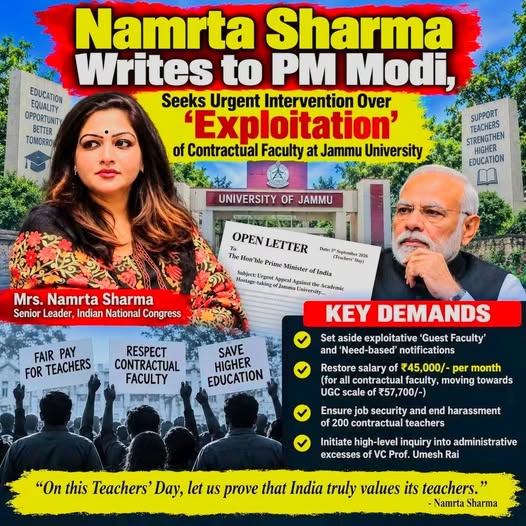
Jammu : Senior Congress leader Mrs. Namrta Sharma has taken the initiative to approach Prime Minister Narendra Modi, urging his immediate intervention in the alleged administrative and academic crisis at the University of Jammu, particularly over the treatment, remuneration and job security of contractual Assistant Professors.
In an open letter addressed to the Prime Minister on Teachers’ Day, Sharma raised serious concerns over what she described as the “systematic economic exploitation, mental harassment and humiliation” of contractual faculty members and alleged that the prevailing situation could adversely affect the academic functioning of the university.
The intervention comes amid protests by student leaders, who have also expressed concern over the uncertainty surrounding contractual teachers and its possible impact on classroom teaching. During a media interaction, one of the protesting student leaders alleged that a “pre-planned nexus” was operating within the university and claimed that students and teachers were being made to bear the consequences of the ongoing administrative dispute.
Sharma, in her letter, has sought the Prime Minister’s intervention with the Ministry of Education and the Chancellor of the University of Jammu, urging that the recently introduced “Guest Faculty” and “Need-based Temporary Academic Arrangement” mechanisms be reviewed and that contractual Assistant Professors be provided a uniform and dignified remuneration.
She has demanded restoration of a consolidated salary of ₹45,000 per month for contractual Assistant Professors, while advocating movement towards the ₹57,700 basic scale referred to in the representation in connection with UGC norms.
The Congress leader has also alleged that similarly qualified contractual teachers are being subjected to different remuneration structures depending upon whether they are teaching undergraduate or postgraduate courses or are posted at different campuses and departments.
According to the letter, certain contractual Assistant Professors associated with the newly introduced UG programme and other units are being offered a consolidated ₹45,000 monthly remuneration, while teachers in some postgraduate departments have allegedly been shifted to a lecture-based Guest Faculty arrangement carrying ₹800 per lecture and a maximum monthly ceiling of ₹35,000.
Sharma has termed the alleged disparity “blatant and unjustifiable discrimination” and questioned why teachers possessing similar qualifications and performing similar academic responsibilities should be governed by different remuneration structures.
Judicial dispute at the centre of controversy
The letter also raises the issue of five contractual Assistant Professors whose services were terminated in 2025. Sharma states that the termination was challenged before the Central Administrative Tribunal, the High Court of J&K and Ladakh and subsequently the Supreme Court.
She alleges that subsequent administrative measures, including the introduction of a “Need-based Temporary Academic Arrangement,” were adopted instead of restoring the earlier contractual arrangement in the manner required by the judicial directions.
The representation further refers to an Academic Council meeting held on July 21, 2026, following which applications were invited under the new nomenclature.
Students raise alarm over academic impact
The controversy has meanwhile spilled onto the university campus, with various student protests being reported against the prevailing situation.
Student leaders have demanded clarity from the university administration regarding the deployment and remuneration of contractual teachers, maintaining that uncertainty among faculty could directly affect students’ academic interests.
One student leader, while addressing the media, alleged that the developments were part of a “pre-planned nexus” and questioned whether students were being deliberately pushed into an academic crisis.
The protesters claimed that the issue was no longer limited to the contractual faculty but had become a matter concerning the functioning of the university and the future of thousands of students.
Concern over offsite campuses
Sharma’s letter also highlights the alleged dependence of several University of Jammu offsite campuses, including Udhampur, Reasi, Kishtwar, Ramnagar and Poonch, on contractual teaching staff.
The representation claims that the absence of adequate permanent faculty at these campuses makes contractual teachers crucial for maintaining regular academic activity.
The Congress leader has therefore urged authorities to act urgently so that students do not suffer because of the ongoing administrative uncertainty.
Sharma seeks independent inquiry
Apart from seeking restoration of the earlier remuneration structure, Sharma has called for an independent, high-level inquiry into the allegations of administrative excesses, arbitrary appointments, alleged favouritism and violations of government norms during the tenure of Vice Chancellor Prof. Umesh Rai.
The letter also raises allegations concerning extensions and promotions granted to Prof. Anju Bhasin while she was reportedly on leave and residing abroad. These allegations have been made in the representation and would require verification from official records and a response from the concerned authorities.
“Teachers’ Day message to the Centre”
Linking her appeal to Teachers’ Day, Sharma questioned how India could aspire to become a global knowledge leader while highly qualified teachers allegedly face financial insecurity and professional uncertainty.
She urged the Prime Minister’s Office, the Union Ministry of Education and the J&K administration to intervene before the dispute further affects teaching and academic activities at the University of Jammu.
With student protests adding pressure to the administration and Sharma’s appeal now placed before the Prime Minister, the controversy over contractual faculty has emerged as a major issue concerning the academic functioning of the University of Jammu.
The allegations contained in Sharma’s letter and those raised by protesting students remain allegations and are subject to verification. The University administration and the officials named in the representation have the opportunity to present their response and clarify the basis of the decisions under question.