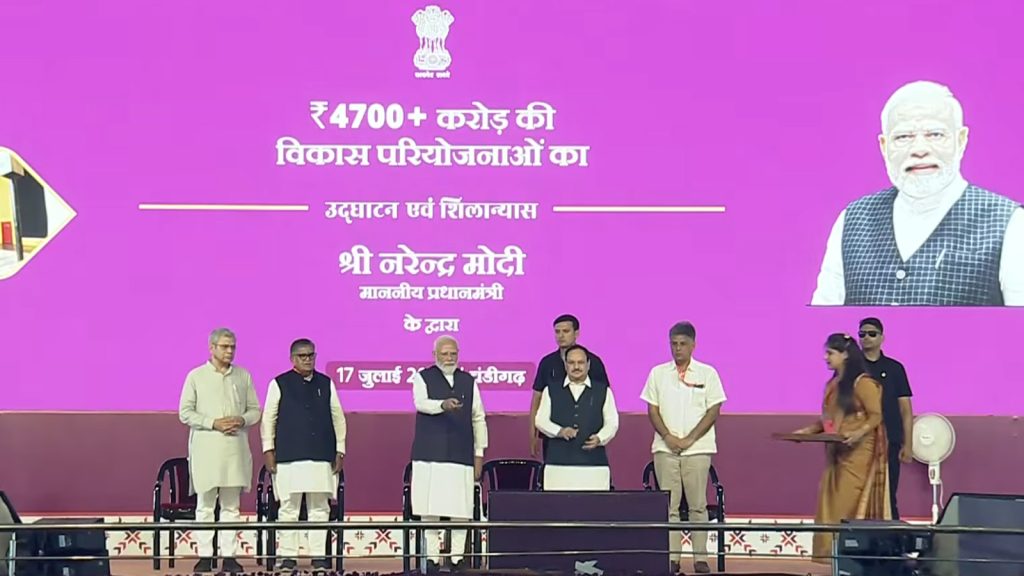
PM Modi Inaugurates, Lays Foundation Stone Of Projects Worth Rs 4,700 Crore In Chandigarh; Says City Is ‘Model Of Development’ For India

Prime Minister Narendra Modi on Friday inaugurated and laid the foundation stone for development projects worth over ₹4,700 crore in Chandigarh, covering healthcare, education and road infrastructure. Describing Chandigarh as a benchmark for planned urban development, he said the city’s progress benefits not only the Union Territory but also neighbouring Punjab, Haryana, Himachal Pradesh and Jammu and Kashmir.
Addressing a public gathering, the Prime Minister said, “Chandigarh is not just a city; it has been a model of development for India. Chandigarh is known for its organized development, a better lifestyle and ease of living. It is recognized for its superior medical facilities, and along with all this, Chandigarh is blessed by Maa Chandi. Therefore, the development of Chandigarh has always been a priority for the NDA government.”
Highlighting reforms undertaken during the NDA government’s tenure, the PM recalled that Chandigarh became the first place where the Bharatiya Nyaya Sanhita was implemented after replacing the colonial-era penal laws.
“We replaced the Penal Code with the Bharatiya Nyaya Sanhita. This means moving from a punishment-based legal system to a justice-based legal system. The implementation of the Bharatiya Nyaya Sanhita commenced right here from Chandigarh,” PM Modi said.
He said Chandigarh has undergone a major transformation under the Smart City Mission through projects such as the Integrated Command and Control Centre, smart traffic management, smart parking and digital governance.
“More than ₹2,500 crore has been spent on this mission. Today, several development works related to health, education and infrastructure are also kicking off here. I congratulate all residents of Chandigarh for these initiatives,” the Prime Minister said.
Emphasising Chandigarh’s regional importance, PM Modi said the city serves as a vital hub connecting northern states.
“Before arriving here, I was in Jind, Haryana, and after this program, I have to go to Jalandhar for Punjab’s development projects. This is because our Chandigarh connects this entire region comprising Haryana, Punjab, Himachal Pradesh and Jammu & Kashmir. While Chandigarh’s development transforms the lives of its own residents, it also immensely benefits the people of Haryana, Himachal Pradesh, Punjab and Jammu & Kashmir. In terms of medical services, Chandigarh is a major hub for this entire region,” the PM said.
Recalling his association with the Postgraduate Institute of Medical Education and Research (PGIMER), the Prime Minister said he frequently visited the institute during his stay in Chandigarh because many colleagues and their family members from neighbouring states sought treatment there.
“I know firsthand how vital this centre is for the health and well-being of the people across this entire region,” he said.
PM Modi inaugurated the Advanced Mother and Child Centre and the Advanced Neurosciences Centre at PGIMER, besides laying the foundation stone of a 150-bed Critical Care Hospital Block under the Pradhan Mantri Ayushman Bharat Health Infrastructure Mission.
The PM said, “Projects like the Advanced Neurosciences Centre, the Advanced Mother and Child Centre, and the Critical Care Hospital Block will provide millions of people with even better treatment facilities.”
Recalling his visit to PGIMER’s convocation in 2015, the Prime Minister added, “I am delighted that today I have the opportunity to virtually meet all my old colleagues there. Since then, over the course of this decade, PGI’s capacities have expanded significantly. I commend the management, professors, and young doctors of PGI Chandigarh, and extend my best wishes to them.”
Speaking about sanitation, PM Modi said cleanliness is fundamental to better healthcare and reiterated the importance of the Swachh Bharat Mission.
“When we talk about health, we all know how crucial a role cleanliness plays. That is why we launched the Swachh Bharat Mission. Cleanliness is not a one-day job; it is a way of life,” he said.
The Prime Minister also praised retired IPS officer Inderjit Singh Sidhu, popularly known as the “Broom Warrior”, for inspiring citizens to participate in cleanliness drives.
“He has ignited a new flame of cleanliness in Chandigarh and inspired people. For his efforts, our government has honoured him with the Padma Shri this year,” he said.
Appreciating the “Swachhata Se Swagat” campaign organised ahead of his visit, PM Modi said, “I saw on social media that all leaders as well as the general public were actively participating in the cleanup. I personally congratulate all the brothers and sisters of Chandigarh with great pride for this initiative.”
Highlighting India’s healthcare transformation over the past decade, the Prime Minister said the country’s global image had changed dramatically.
“There was a time when the entire world expressed concern over India’s health sector. During the COVID-19 pandemic, India was at the centre of global concern. However, our government transformed both India’s capability and the world’s perception. When the pandemic struck, India was not a nation begging for help; instead, India was sending aid to the world. Today, people from numerous countries come to India for the treatment of serious illnesses. India is emerging as a major destination for medical tourism,” he said.
PM Modi said the transformation was driven by sustained investments in healthcare infrastructure.
“Since 2014, 15 new AIIMS have been approved. Hundreds of new medical colleges have been established across the country. The Homi Bhabha Cancer Hospital in Chandigarh, which I inaugurated in 2022, is today serving thousands of patients,” he said.
The Prime Minister also highlighted the Ayushman Bharat Health Infrastructure Mission and digital healthcare initiatives.
“Nearly 1.75 lakh Ayushman Arogya Mandirs are operational across urban, rural and tribal areas. Our government is also leveraging technology through the E-Sanjeevani Mission. More than 48 crore telemedicine consultations have taken place so far,” he said.
Referring to improvements in public health indicators, PM Modi said institutional deliveries have crossed 90 per cent while maternal and infant mortality have declined significantly.
He stressed that preventive healthcare has become a key pillar of government policy.
“Through initiatives like Poshan Abhiyaan, Mission Indradhanush, Yoga, HPV Vaccination and the U-WIN platform, the lives of crores of people are being secured,” the Prime Minister said.
On the government’s campaign against tuberculosis, he said, “We have resolved to make India TB-free. TB treatment coverage has surpassed 90 per cent. According to a WHO report, TB infections have dropped by 21 per cent within 10 years. Health services in India are no longer a privilege; they are becoming a right for every common citizen.”
PM Modi also highlighted reforms in medical education.
“Today, the number of medical colleges in the country has nearly doubled. There has been a record increase in MBBS and postgraduate seats. An MBBS college has now been approved at Chandigarh PGI, and admissions will begin soon. This will give numerous talented youths the opportunity to study at such a top institution and provide the nation with a large number of excellent doctors,” the PM said.
In the education sector, the Prime Minister inaugurated the Kurukshetra Boys Hostel and Mess at Punjab Engineering College, a hostel block at Government College, Sector 46, and laid the foundation stone for a Research Scholars’ Hostel at Punjab Engineering College.
He said Chandigarh possesses exceptional academic potential.
“Chandigarh is a city where major institutions related to education, engineering, medical science and research coexist. These institutions can become major hubs for new technology, healthcare, startups and innovation. We want to propel India forward in fields like Artificial Intelligence, semiconductors, advanced manufacturing and deep-tech. I am fully confident that Chandigarh’s educational institutes, teachers and youth will play a vital role in this direction,” PM Modi said.
The PM also inaugurated the six-lane Greenfield Highway from IT City to Kurali and laid the foundation stone for the PR-7 Spur of the Ambala-Chandigarh Greenfield Highway.
“Infrastructure development is the roadmap for any country’s economic progress. A six-lane Greenfield Highway from IT City to Kurali has been inaugurated. This will reduce traffic pressure on Airport Road and provide relief from congestion to the people of Mohali and Kharar. All such development works will boost industry and business, further improving the Ease of Living in Chandigarh,” the Prime Minister said.
Referring to regional connectivity, PM Modi said railway projects in Jalandhar and the country’s first hydrogen-powered train launched earlier in the day from Jind to Sonipat marked significant milestones.
“Increasing the focus on regional connectivity, railway projects are also set to be dedicated to the nation in Jalandhar today. Furthermore, India’s first hydrogen train has started from Jind to Sonipat in Haryana today. This train running on clean fuel marks a monumental beginning. I congratulate all of you and the citizens of our country for this milestone,” PM Modi said.
Concluding his address, the Prime Minister underlined the government’s vision for a developed India.
“In the journey toward a developed India, we must move forward with modern thinking dedicated to the technology, transportation and health services of the future. We must make decisions that benefit not just the current generation, but future generations as well. We must build institutions that grow stronger over time. The BJP-NDA government is moving rapidly in this direction. I once again congratulate the people of Chandigarh, Punjab, Haryana, Himachal and this entire region for these new projects.”