Supreme Court Mandate on Sikh Marriages: Anand Karaj to Get Uniform Legal Recognition Across India
||Black and White Digital News ||
||Parvinder Singh December 30,2025 ||
New Delhi/Jammu: In a landmark judgment with far-reaching constitutional and social implications, the Supreme Court of India in Amanjot Singh Chadha v. Union of India (September 2025) has directed all States and Union Territories to finally operationalise the Anand Marriage Act (AMA), 1909, ensuring uniform and non-discriminatory registration of Sikh marriages (Anand Karaj) across the country.
The ruling addresses decades of administrative inaction that persisted even after the 2012 amendment to the Anand Marriage Act, which explicitly empowered States to frame rules for registration of Sikh marriages. The Court held that continued failure to notify such rules amounted to unequal treatment of Sikh couples, violating constitutional principles of equality, secularism, and dignity.
The Supreme Court issued clear and time-bound directions:
1. Four-Month Deadline:
All States and Union Territories must notify rules under Section 6 of the Anand Marriage Act, 1909, within four months from the date of judgment.
2. Interim Protection for Sikh Couples
Until specific rules are framed, existing marriage registration systems must:
• Accept applications for marriages solemnised through Anand Karaj
• Register such marriages without forcing couples to declare them under other personal laws
• Explicitly mention “Anand rite / Anand Karaj” in the registration certificate if requested
3. No Discrimination on Grounds of Faith
The Court categorically stated that faith cannot be treated as a handicap, and Sikh citizens are entitled to the same ease of access to civil registration as followers of other religions.
Why the Judgment Was Necessary:
The Anand Marriage Act, enacted in 1909, legally recognised the Sikh marriage ceremony. However:
• For decades, there was no formal registration mechanism
• The 2012 amendment required States to frame rules — but many failed to do so
• Sikh couples were often compelled to register marriages under:
• The Hindu Marriage Act, or
• The Special Marriage Act
This created legal ambiguity and symbolic erasure of religious identity, leading to unequal treatment in matters involving:
• Inheritance
• Maintenance
• Divorce
• Succession
• Proof of marital status for passports, visas, and government benefits
The petitioners argued — and the Court agreed — that this administrative vacuum violated Articles 14, 15, and 25 of the Constitution.
Constitutional Significance:
The Supreme Court strongly linked the issue to foundational constitutional values:
• Equality before law (Article 14) — Unequal access to marriage registration was impermissible
• Freedom of religion (Article 25) — Recognition of Anand Karaj is integral to Sikh religious practice
• Secularism — The State must neutrally facilitate all faiths, not privilege or disadvantage any
The Court observed that “administrative delay cannot be allowed to dilute statutory rights, particularly when identity, dignity, and civil consequences are involved.”
Impact on Jammu & Kashmir:
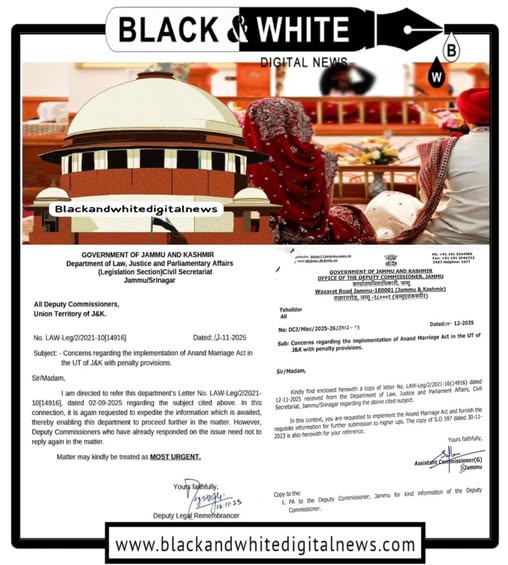
Following the judgment, the Department of Law, Justice and Parliamentary Affairs, UT of Jammu & Kashmir, has intensified efforts to ensure compliance.
In an official communication dated November 2025, the department:
• Expressed concern over delays in implementing the Anand Marriage Act
• Sought urgent information from all Deputy Commissioners
• Emphasised framing of rules with penalty provisions
• Clarified that officers who have already responded need not reply again
• Marked the matter as “MOST URGENT”
Importantly, Tehsildars across the UT have now been instructed to:
• Implement the directions in letter and spirit
• Ensure that all certificates issued to Sikhs under the Anand Marriage Act are properly recorded and recognised
This marks a crucial administrative step towards ending uncertainty for Sikh couples in the Union Territory.
Why This Matters on the Ground:
The judgment ensures:
• Uniform statutory recognition of Sikh marriages nationwide
• Legal certainty for Sikh families in civil and property matters
• Respect for religious identity without forcing assimilation into other legal frameworks
• Administrative accountability, after decades of non-implementation
Legal experts note that the ruling also sends a strong message to governments that statutory rights cannot remain on paper due to executive inaction.
With the Supreme Court’s firm deadline and monitoring, States and UTs are now under constitutional obligation to act. Once rules are notified:
• Anand Karaj marriages will have a clear, standalone registration framework
• Sikh couples will no longer face procedural hurdles or symbolic denial of identity
• India’s commitment to pluralism and equal citizenship will be institutionally reinforced
As the Court succinctly put it, “The promise of equality is hollow unless backed by effective administrative action.”
This judgment transforms that promise into enforceable reality.